50
Regulatory frameworks mapped, from the AI Act to sector guidelines
Genyo Govern AI puts the control, governance and compliance of every AI system you run into a single platform — the EU AI Act, your sector's rules and every national regulator in the EU, with the evidence your supervisors will ask for.
Built for banks, insurers and asset managers. Made in Milan by Redo S.r.l.
Govern what you already run, build what you need next, and control the general-purpose and ML models underneath both.
Inventory, classify and document every AI system. Map it to every obligation that applies, collect the evidence, and hand the supervisor a dossier.
Explore Govern AIBuild AIDesign, develop and maintain AI models on a pipeline engineered for speed — with governance metadata generated as a by-product, not an afterthought.
Explore Build AIToolsQualify general-purpose models, test training data, design human oversight, monitor post-market — and wire in your evaluation and red-team stack.
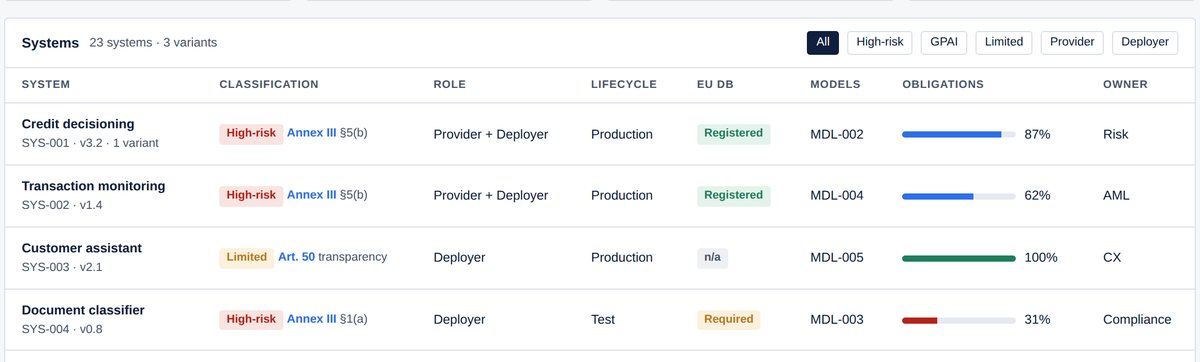
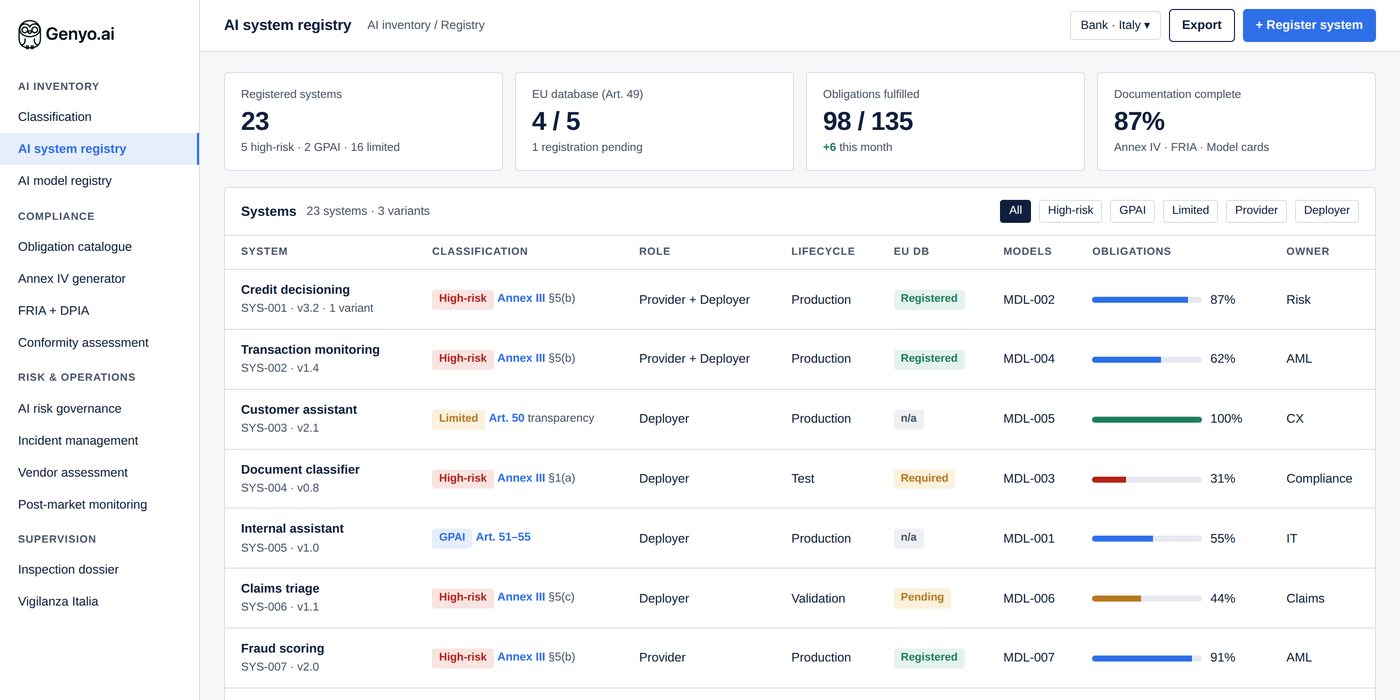
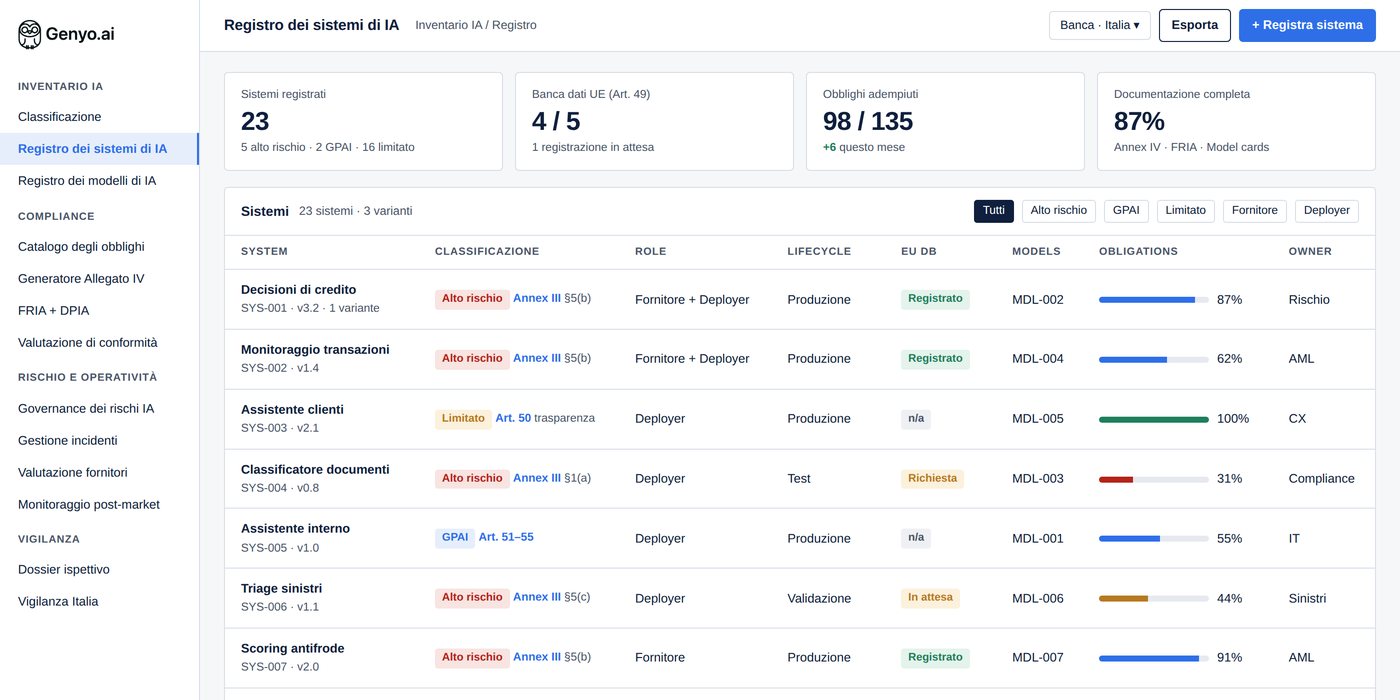
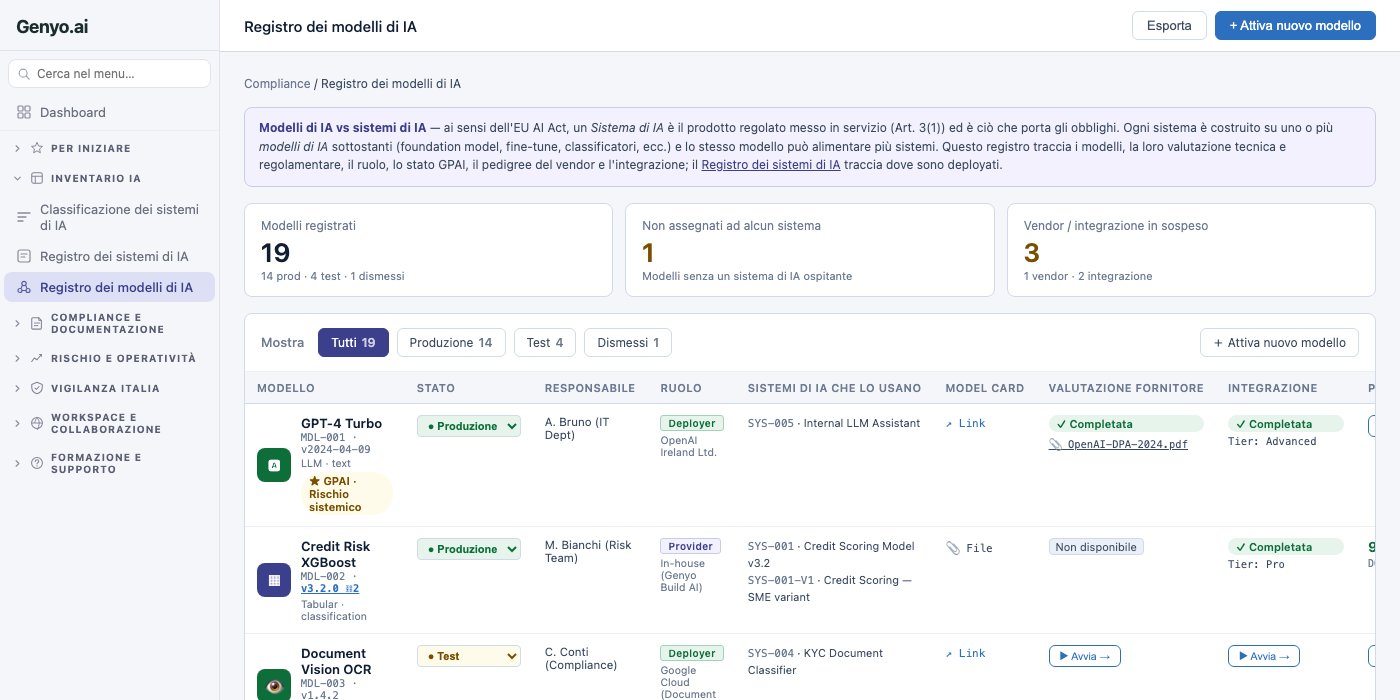
Explore the toolsRisk class, Annex III category, provider or deployer role, lifecycle, EU-database status, models in use and linked risks — one row per system, per entity. This is the register your supervisor will ask to see.
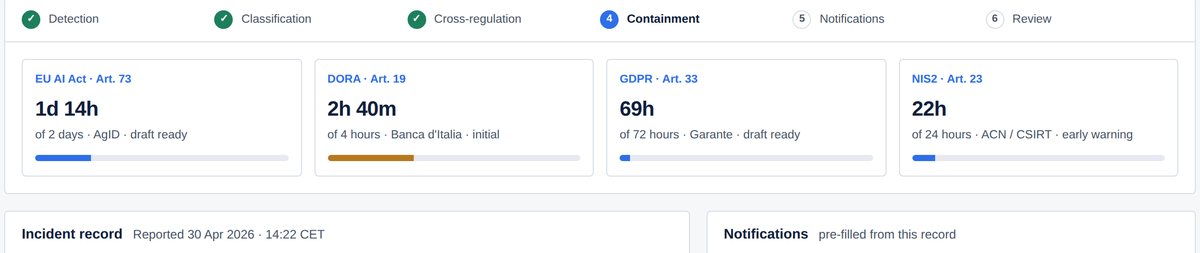
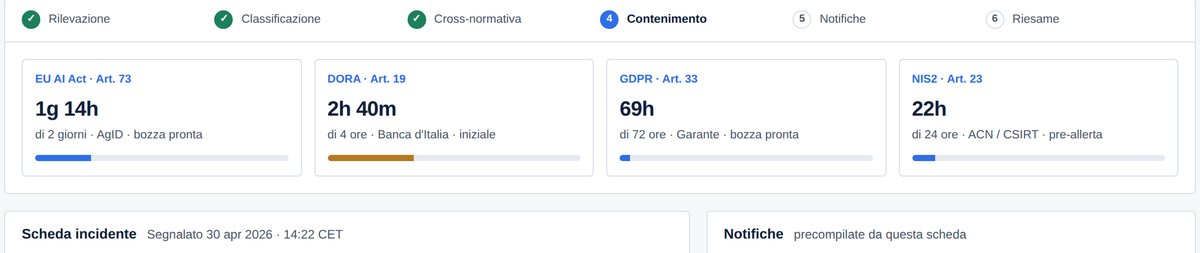
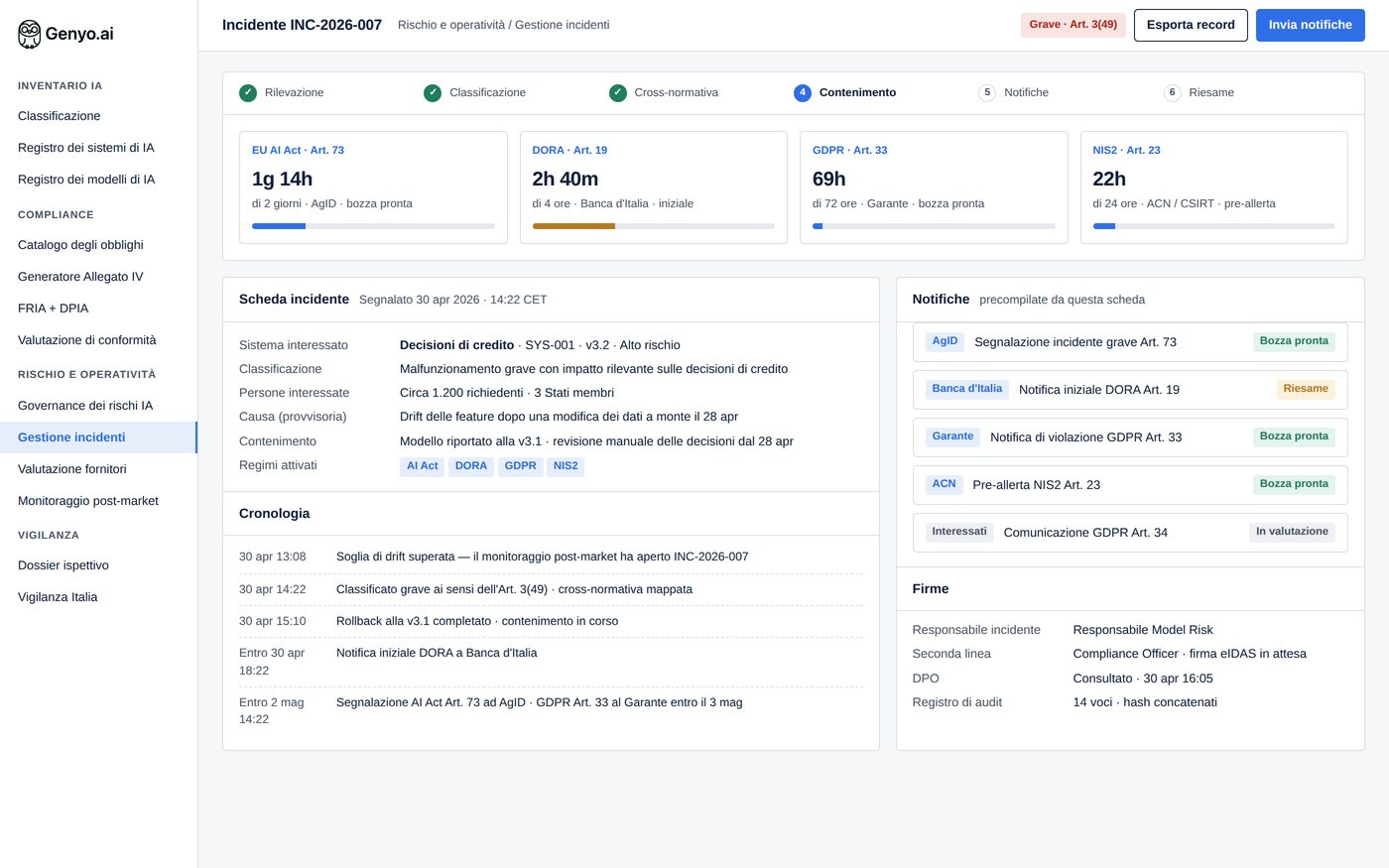
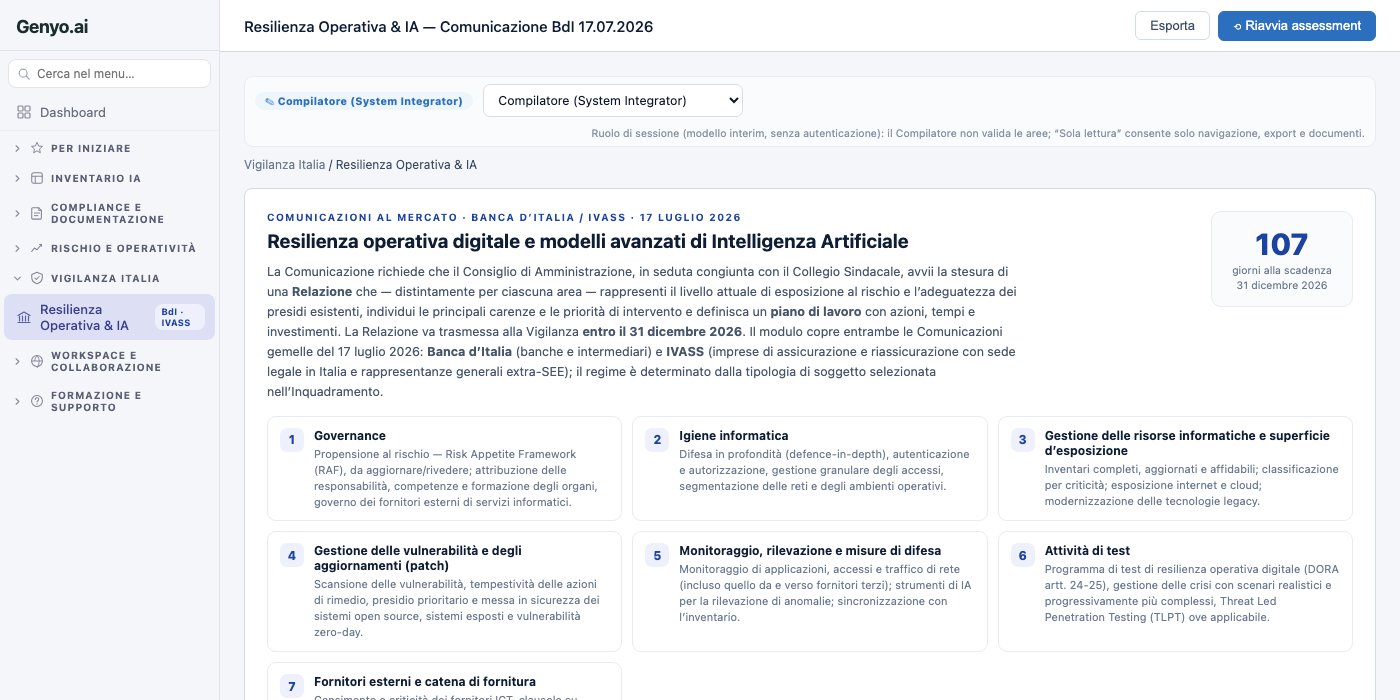
An incident under the AI Act is usually also an incident under DORA and GDPR. Genyo maps every module to every article that binds it, so one action satisfies every regime — with the deadlines of each.
 View the full screen →
The AI Act is European. Its enforcement is national — surveillance authorities, notification templates, sector circulars, labour law. Genyo models the regulators and the national law of all 27 member states, and generates the filings each one expects.
Read-only connectors pull model registries, run metrics, deployment metadata and security signals straight into the evidence base. Nothing is re-keyed.
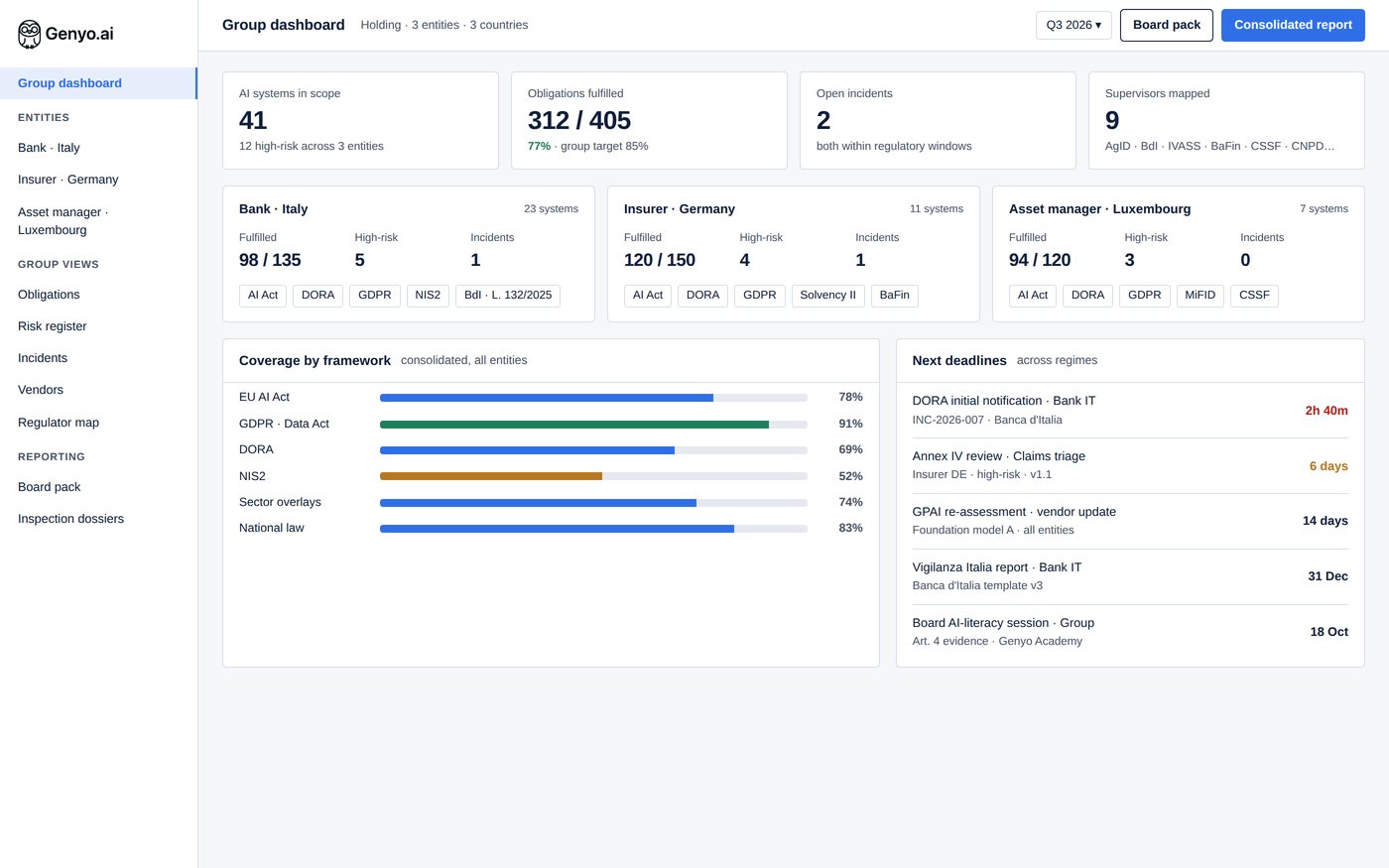
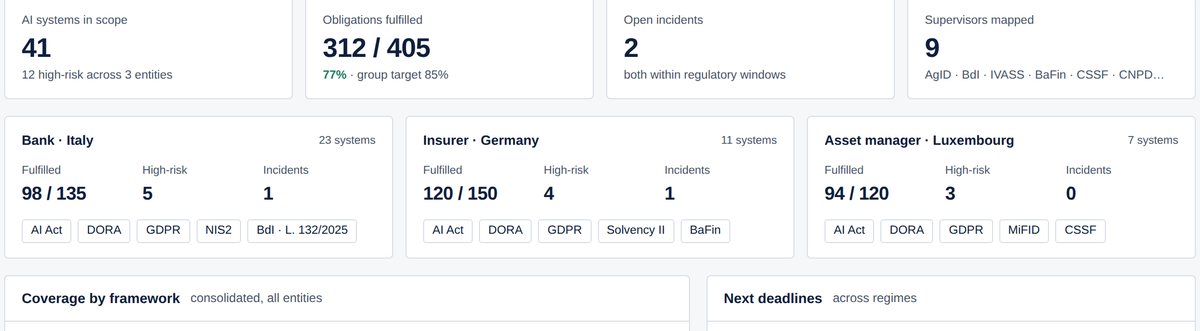
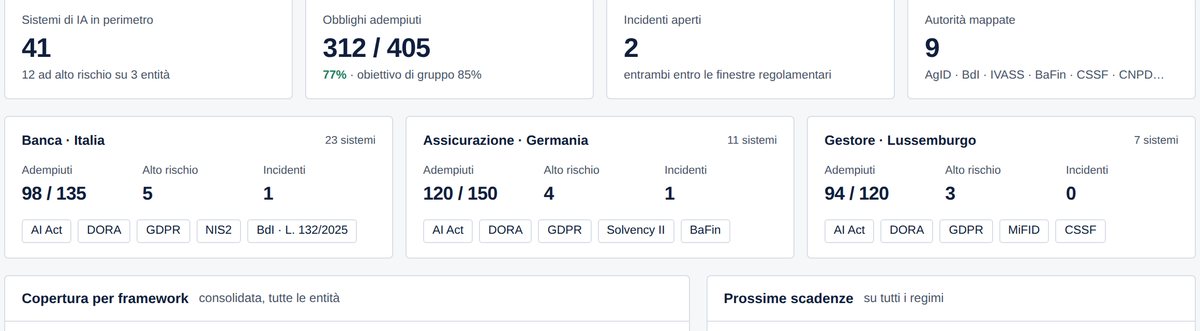
For groups, governance is a consolidation problem. Each legal entity keeps its own register, overlays and supervisors; the holding sees everything rolled up, with separation of duties enforced per entity.
 View the full screen →
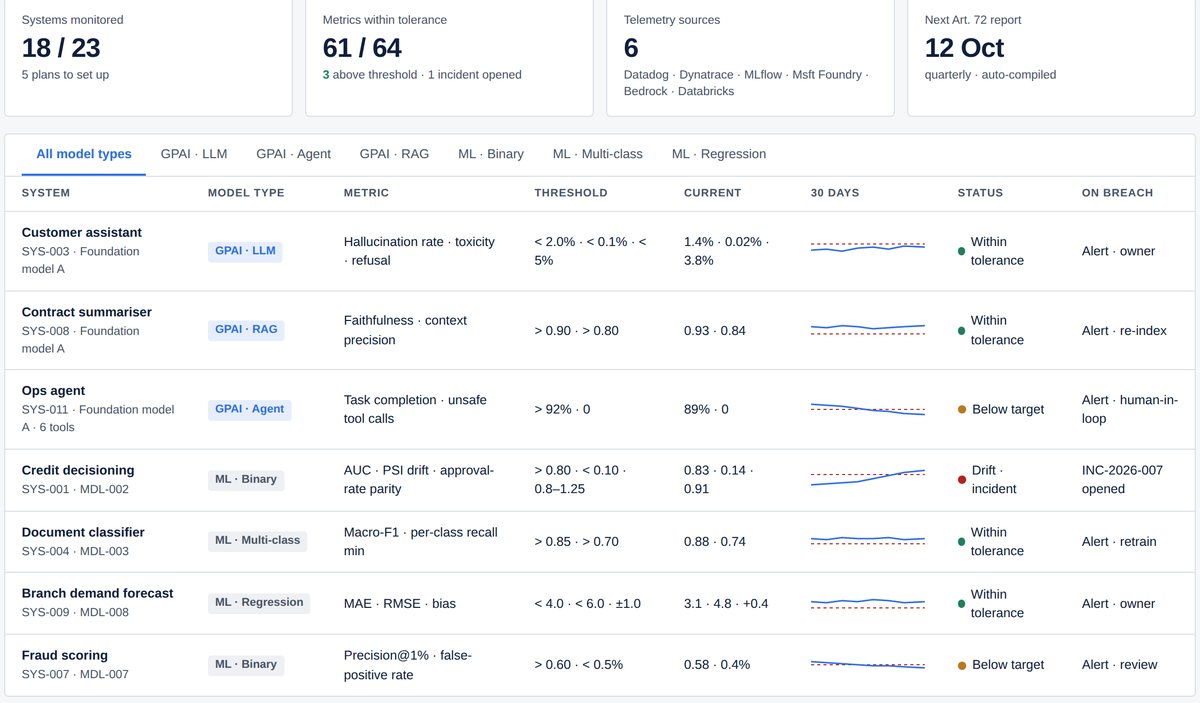
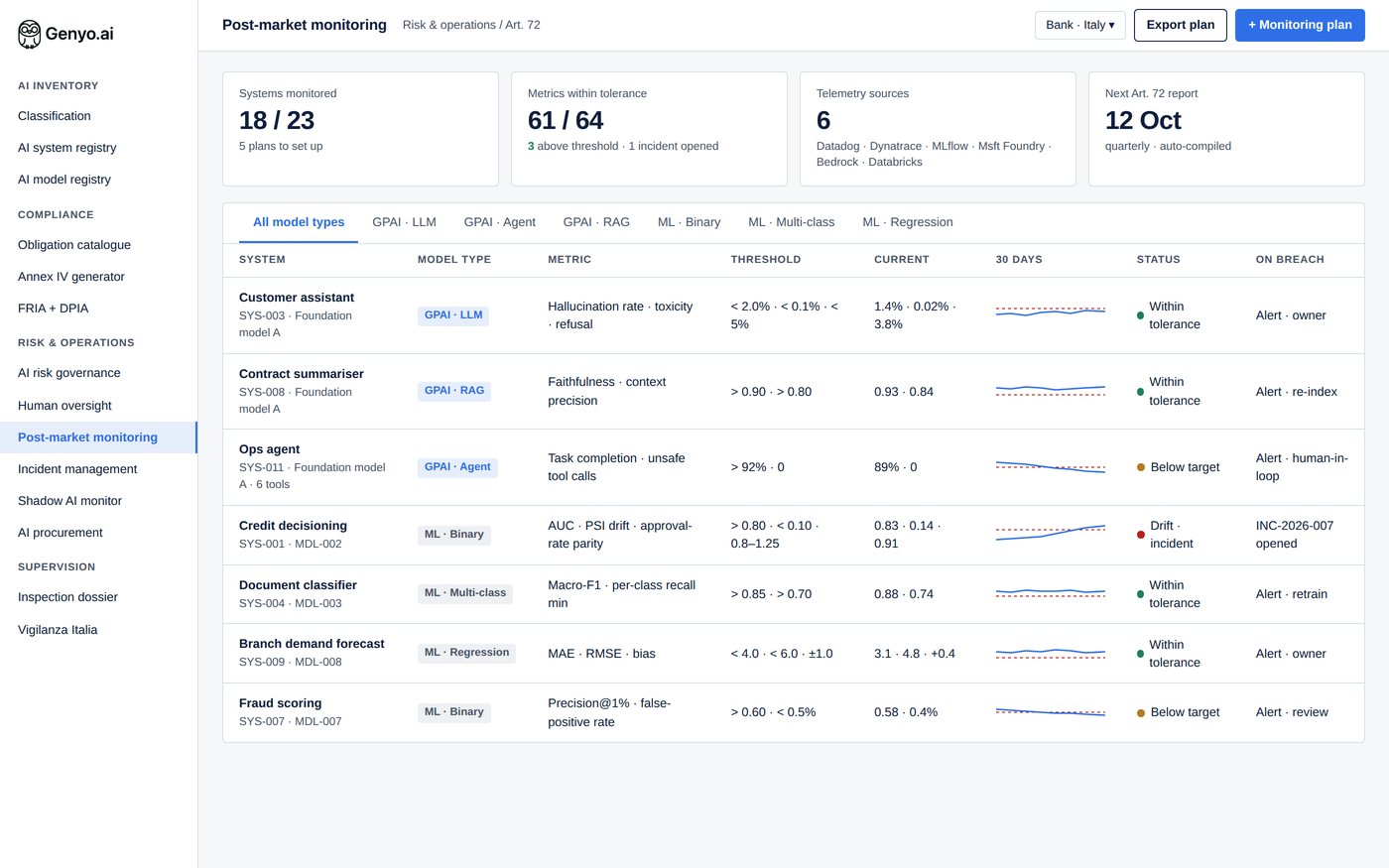
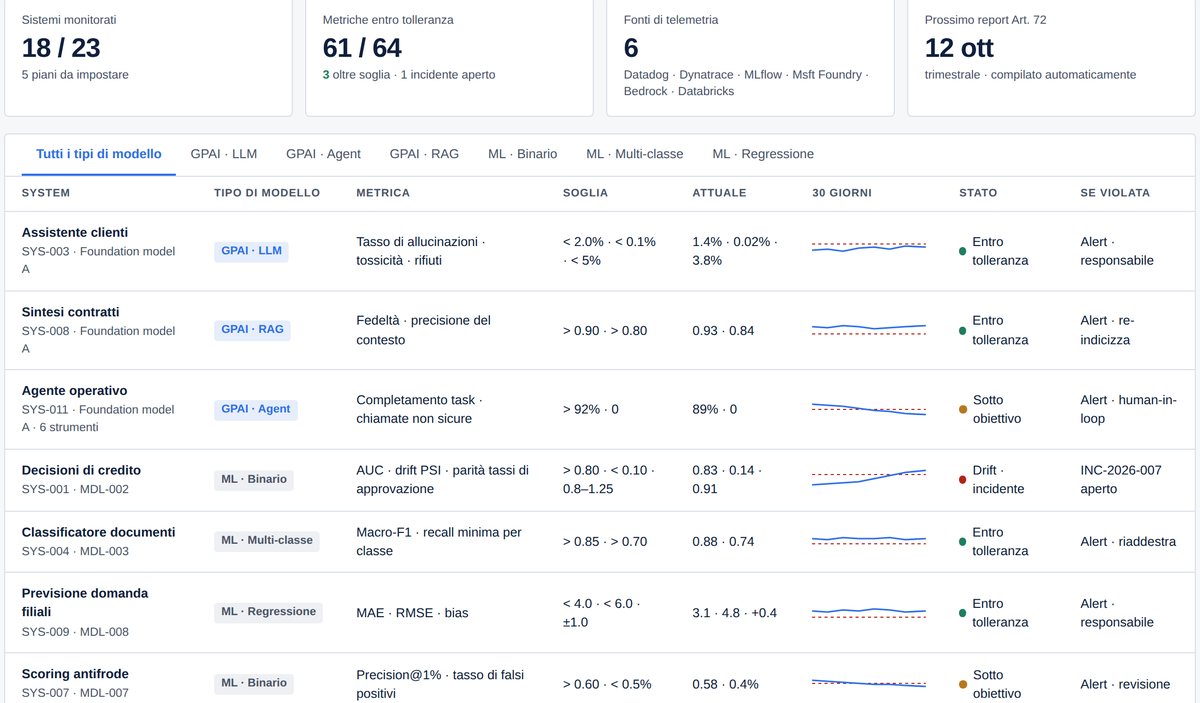
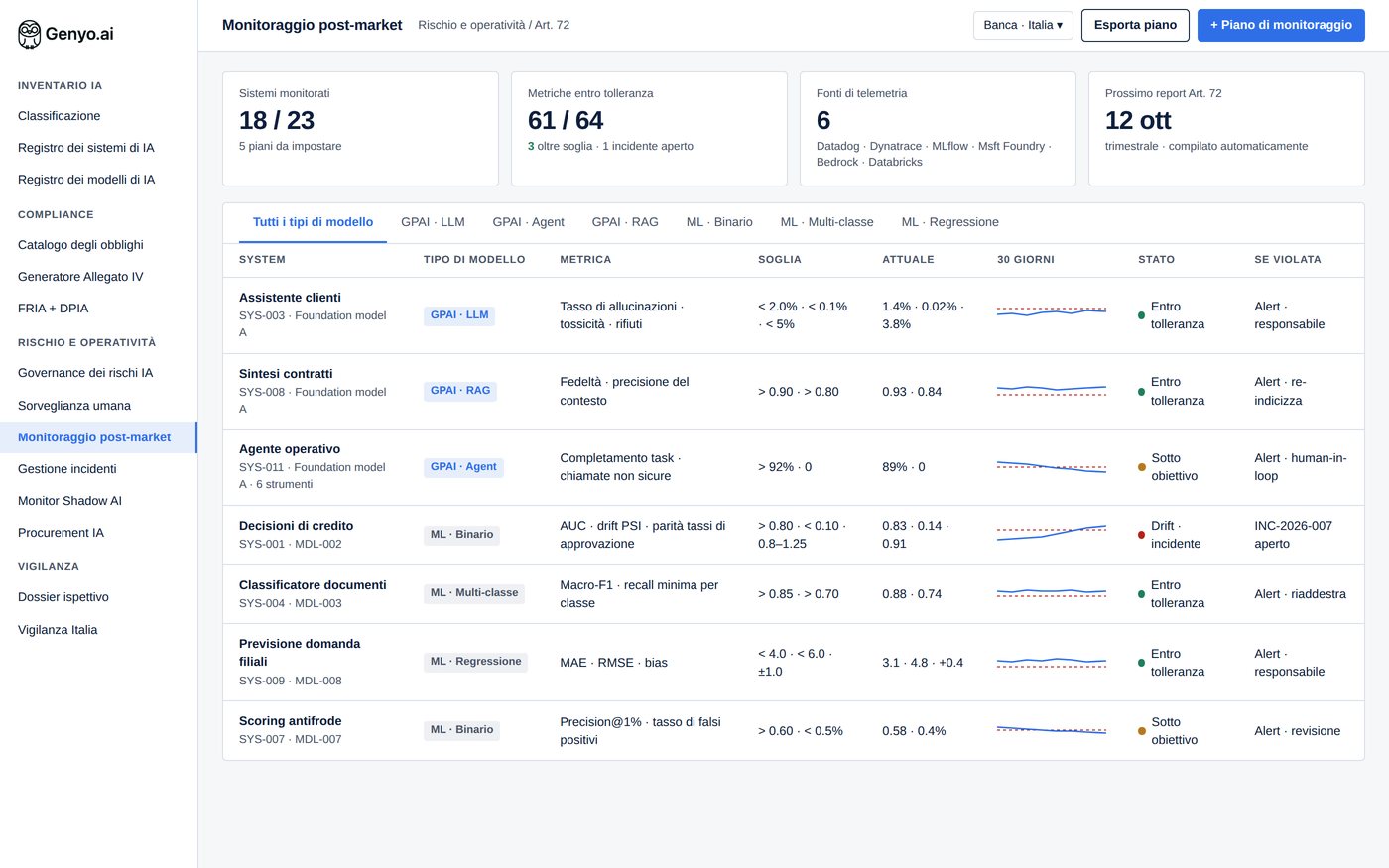
Article 72 asks for a monitoring plan; it does not say what to measure. Genyo ships metric sets per model type, wired to your telemetry, with thresholds that open an incident when crossed.
 View the full screen →
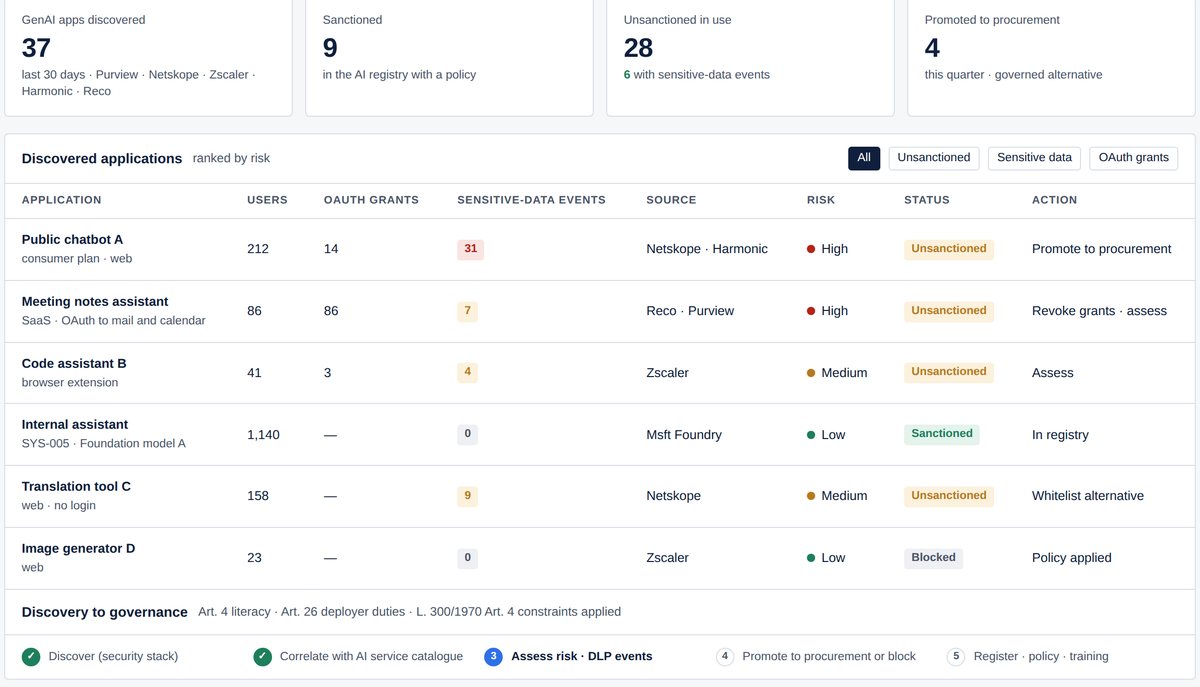
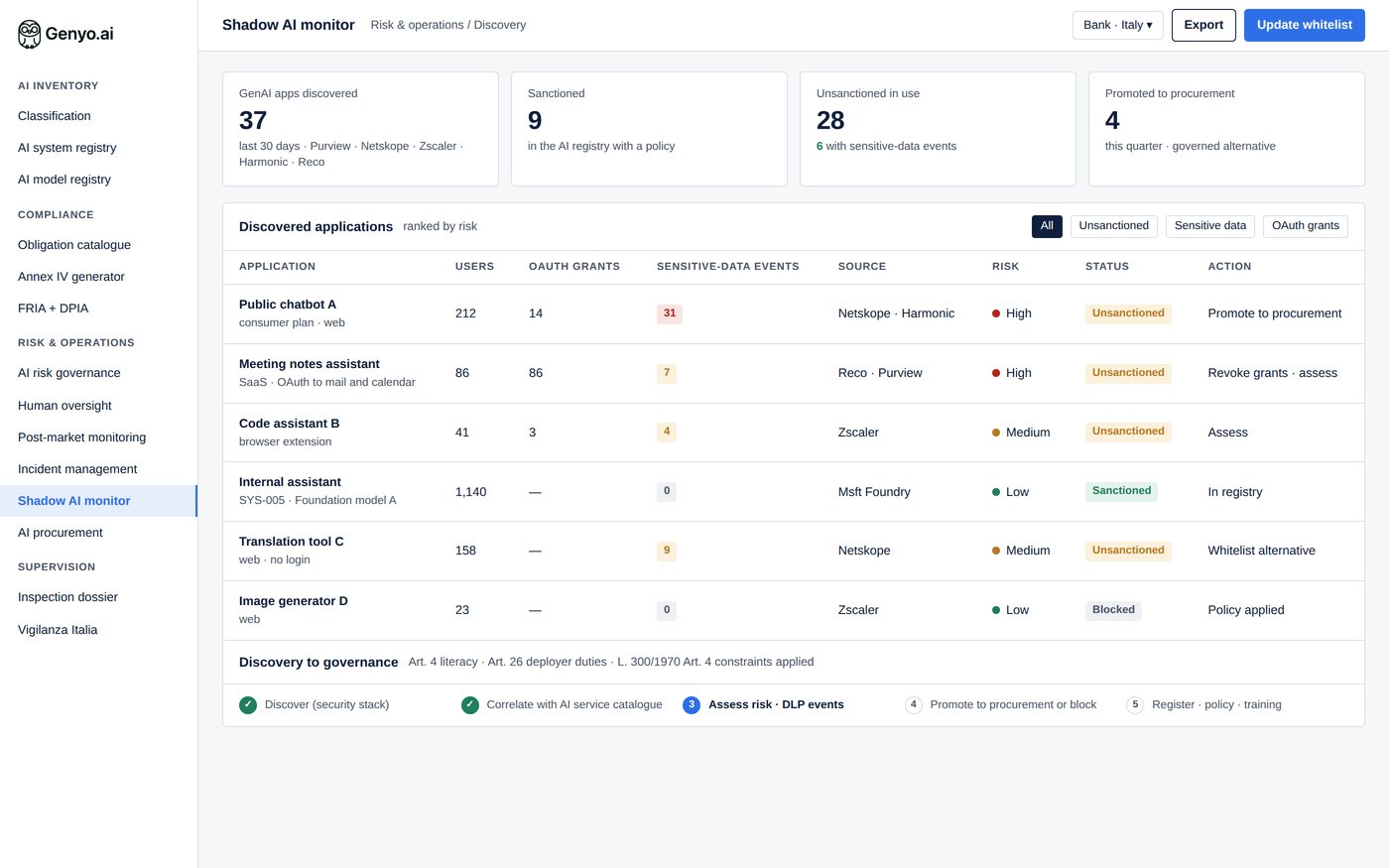
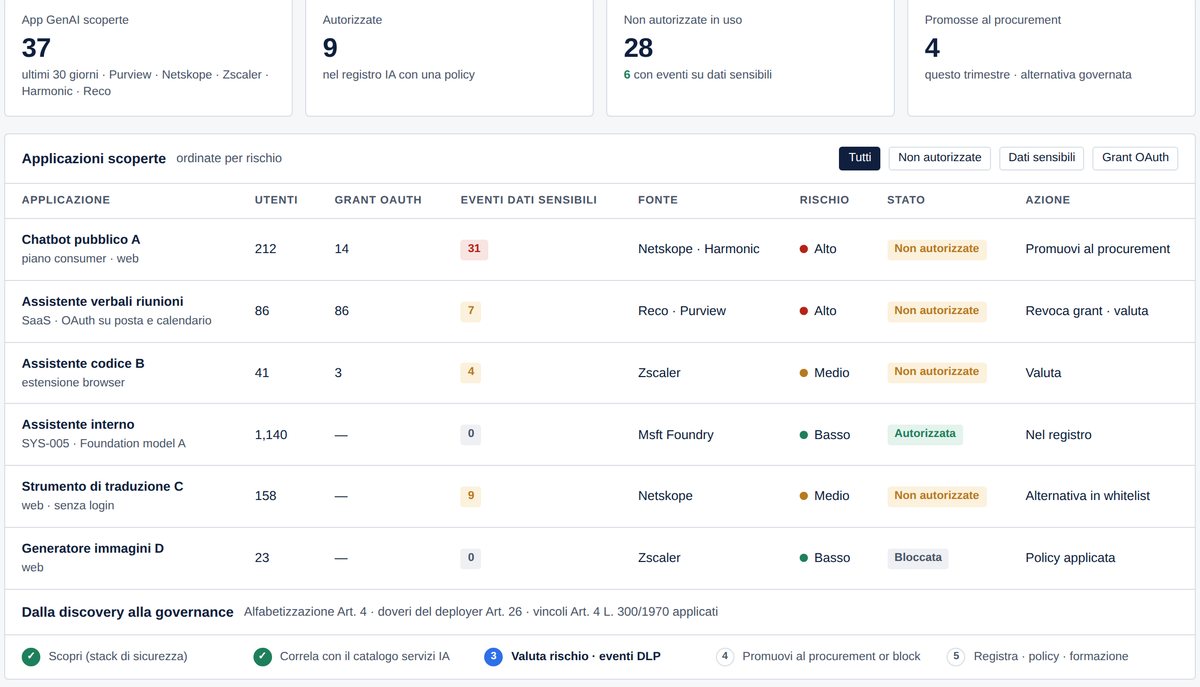
Your security stack already sees the GenAI apps employees use. Genyo reads that inventory, correlates it with the AI service catalogue, scores the risk, and turns unsanctioned use into a governed procurement request — or a block.
 View the full screen →
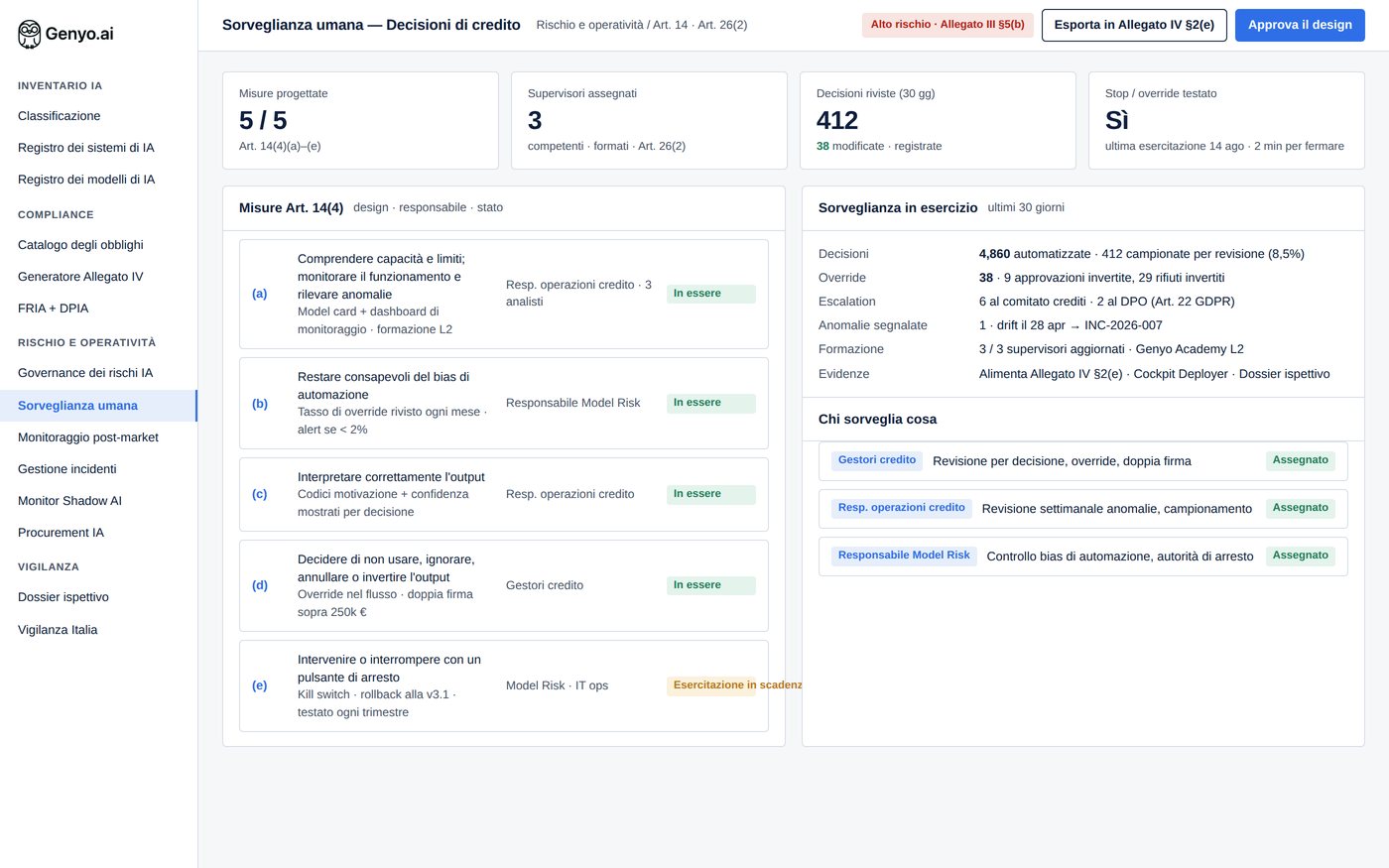
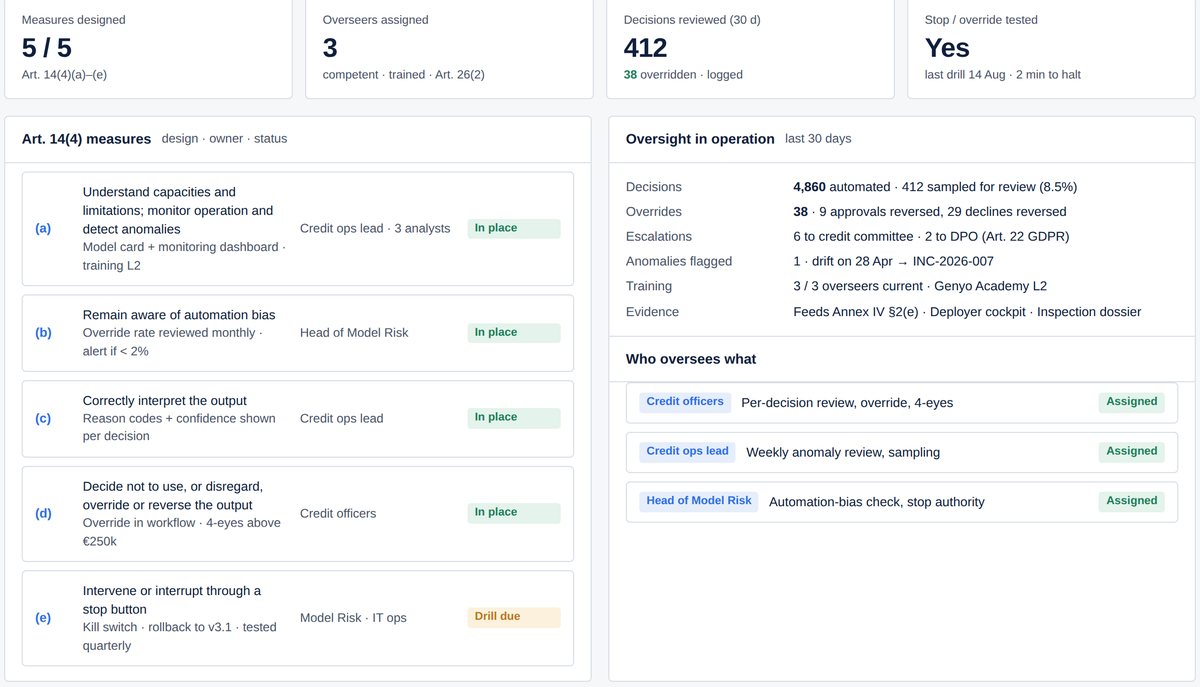
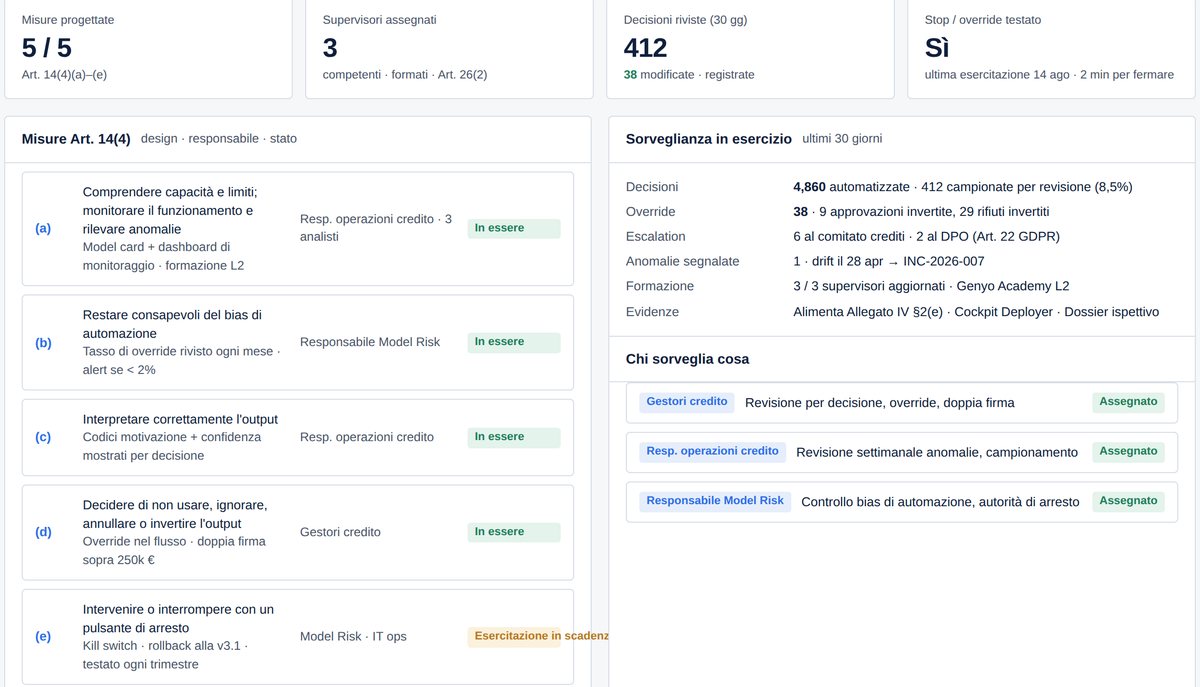
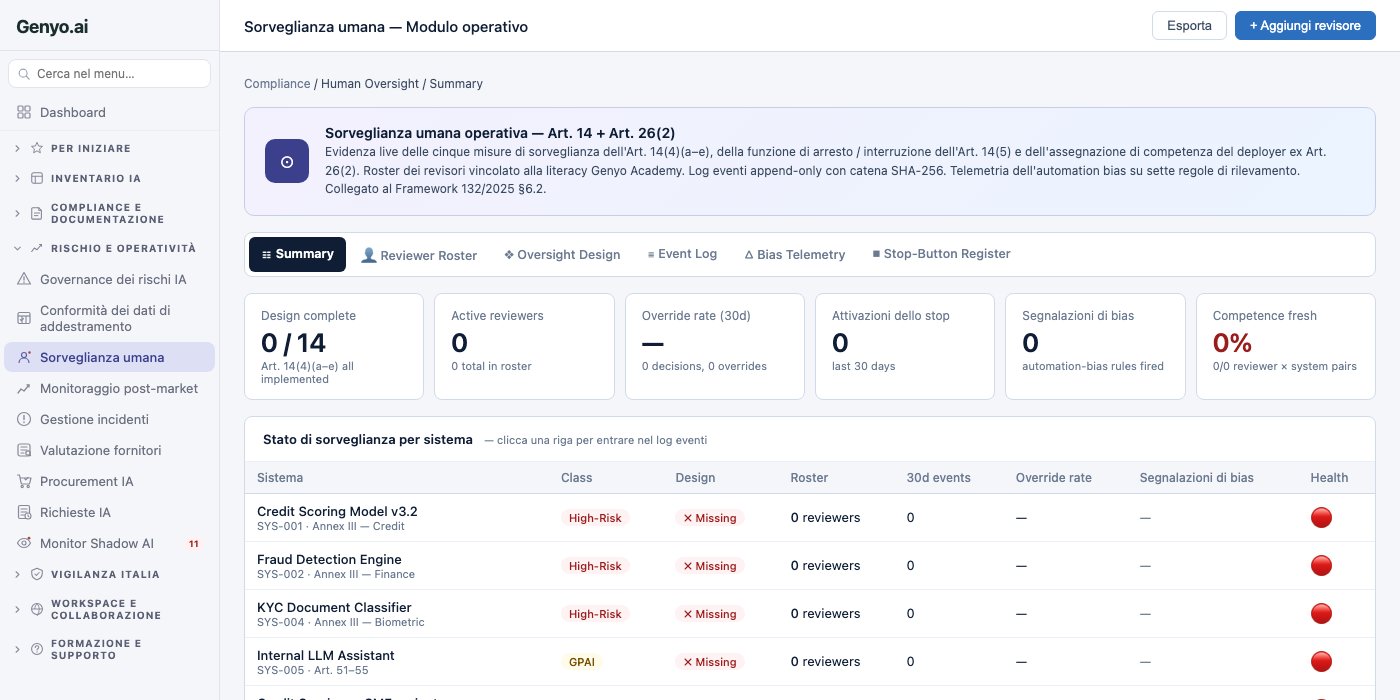
Article 14 requires that a person can understand, question, override and stop a high-risk system. Genyo records the five measures per system, who holds each, and what actually happened in operation.
 View the full screen →
The platform you are looking at — twenty-five modules, fourteen frameworks, eighteen connectors — was designed, developed and is maintained on the Build AI pipeline. It is the fastest way we know to take an AI model from requirement to production, and it produces its own compliance metadata on the way.
Talk to the Build AI teamRedo S.r.l. is the company behind Genyo.ai. We build AI governance software for banks, insurers and asset managers, and we build AI models with the same pipeline.
The AI Act arrived on top of DORA, GDPR, NIS2 and a decade of sector guidelines. Institutions were being asked to govern AI across five regimes with spreadsheets and email.
We had built credit-risk models under supervisory scrutiny and knew what an inspection asks for. Genyo is the register we wished we had had: every system, every obligation, every piece of evidence in one place, in the supervisor's order.
We built it on our own Build AI pipeline, which is why the platform can also produce its own compliance metadata — and why we offer the pipeline to clients.


Redo S.r.l. is ISO/IEC 27001 certified.
Genyo.ai is operated in compliance with DORA requirements for ICT third-party providers to financial entities.
Tell us which entities, frameworks and countries are in scope. We reply within two working days with a proposed 45-minute walkthrough.
We'll get back to you as soon as possible.
You may submit this form without providing your name or contact details. All responses are treated confidentially.
We'll get back to you as soon as possible.
Genyo never writes to your platforms. Each connector reads registries, runs, telemetry or security signals and files them as evidence against the obligations they satisfy.
Tell us which platform you run and what it should feed. Connectors are built on a read-only pattern, so most requests are a matter of weeks.
Request a connectorRedo S.r.l. (hereinafter, the Company), P. IVA: 11601770966, with registered office in Corso Garibaldi, 49, Milano, acknowledges the central role of personal data in the socio-economic ecosystem in which it operates, as well as the critical issues related to their use in the provision of services that involve the non-incidental use of artificial intelligence systems. Accordingly, the Company is fully aware of the importance of clear and transparent communication in order to mitigate risks to the rights and freedoms of all natural persons whose personal data are processed. Furthermore, privacy legislation (in particular Regulation (EU) 2016/679, the "General Data Protection Regulation" — GDPR) requires us to provide you with the following information regarding the processing of your personal data, pursuant to Articles 13 and 14. For these reasons, Redo S.r.l., Corso Garibaldi, 49 — 20121, Milano (MI), as the "Data Controller," hereby provides this privacy notice to describe the modalities for processing your personal data in connection with its website.
It is important to emphasize from the outset that the Company, in the course of its activities, operates both as a Data Controller and as a Data Processor. Since, pursuant to Articles 13 and 14 of the GDPR, the obligation to provide information on processing lies exclusively with the Data Controllers, this document will concern solely the processing activities for which the Company acts as Data Controller. These include activities related to service registration and the operation of the website, concerning the personal data of natural persons who access the site either as visitors or as operators with login credentials, for the purpose of accessing the services provided. However, in the interest of transparency and in the spirit of fair cooperation with the Data Controllers, the Company considers it useful to provide clients with information regarding processing activities carried out in its capacity as Data Processor. These include activities arising from the provision of its typical services (quality checks, enhancement, augmentation of training data, initial model training or re-training, processing and returning of inferences for the purposes chosen by the clients from those available, and retention of original database files for training). To this end, upon request by the client-Controllers, the Data Protection Impact Assessment (DPIA) prepared following the impact assessment pursuant to Article 35 GDPR is available. Extracts of the document may also be made available to third parties, upon request, in the interest of maximum transparency. It should be noted, however, that with regard to processing carried out as a Data Processor, the Company does not determine the specific purposes and categories of personal data used from time to time (which partly depend on the discretionary choices of the clients), the final retention periods of the data, the entities with whom the Controllers choose to share them, or numerous other relevant aspects of processing, except for those specifically related to the technical characteristics of the services provided. Furthermore, the Company cannot directly or autonomously respond to data subject requests, as it does not know the identity of the individuals involved, operating solely on information that is not attributable to specific natural persons (data pseudonymized at source and therefore anonymous from the Company's perspective, which does not possess, nor can it possess, legal or technical means to re-identify the data subjects). Nonetheless, the aforementioned DPIA contains information regarding technical "by design" measures adopted to facilitate the exercise of data subject rights by client-Controllers, in particular with respect to the explainability of AI model inferences and the human oversight of processes ("human-in-the-loop" supervision), in compliance with Article 22 GDPR as well as related regulations on Artificial Intelligence (Reg. (EU) 2025/1689 and sector-specific regulations, e.g., EBA). Finally, it should be noted that operations carried out by the Company for the purpose of developing additional AI models for its own interest are normally performed using synthetic data or data subjected to processes (embedding) that render them fully anonymous and not attributable to identified or identifiable natural persons, and therefore do not constitute processing of personal data within the meaning of Article 4(2) GDPR. Should personal data be used in the future for the purposes described in this paragraph, it will be the responsibility of the Data Controller (whether the Company, the client, or, in the case of joint controllership, the party designated under the agreements to assume the obligation) to inform the data subjects and to ensure the existence of the necessary legal bases.
Every module carries the article that binds it. Together they cover the AI Act, GDPR, DORA, NIS2 and the sector and national overlays — from the first classification to the supervisor's dossier.
Products · Getting started
EU AI Act · L. 132/2025
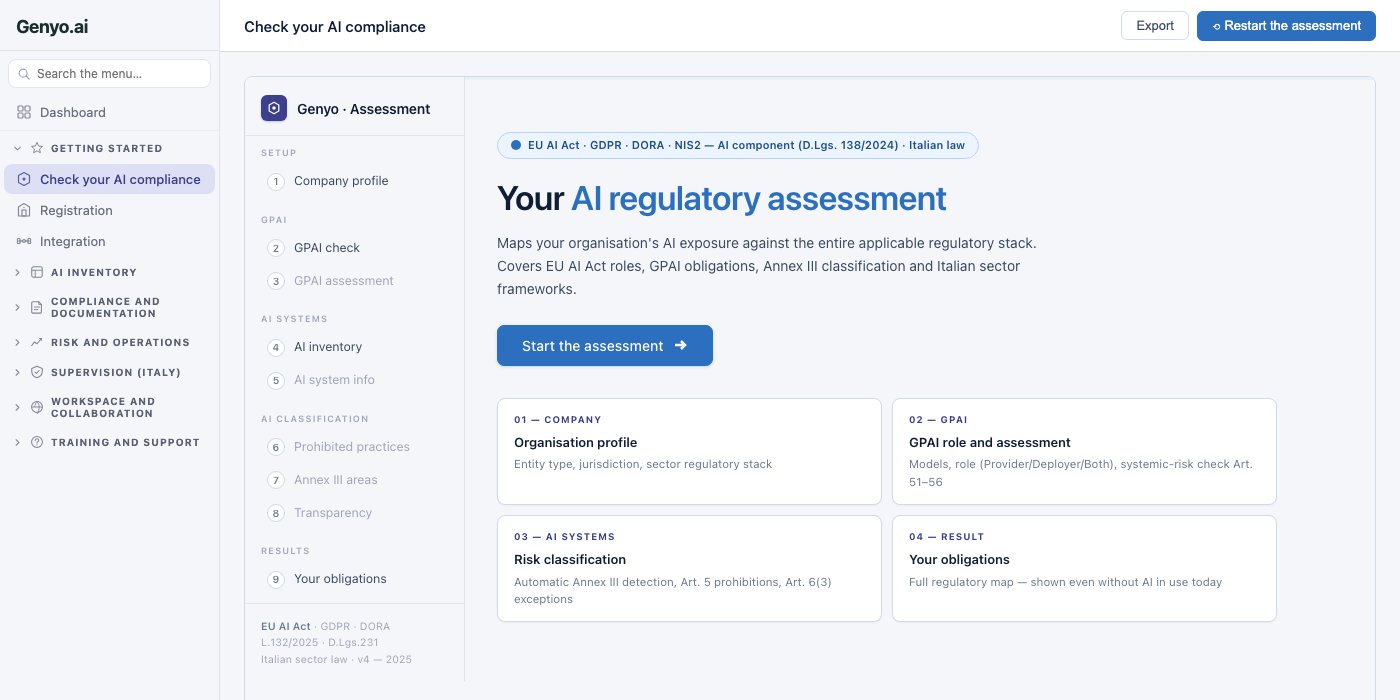
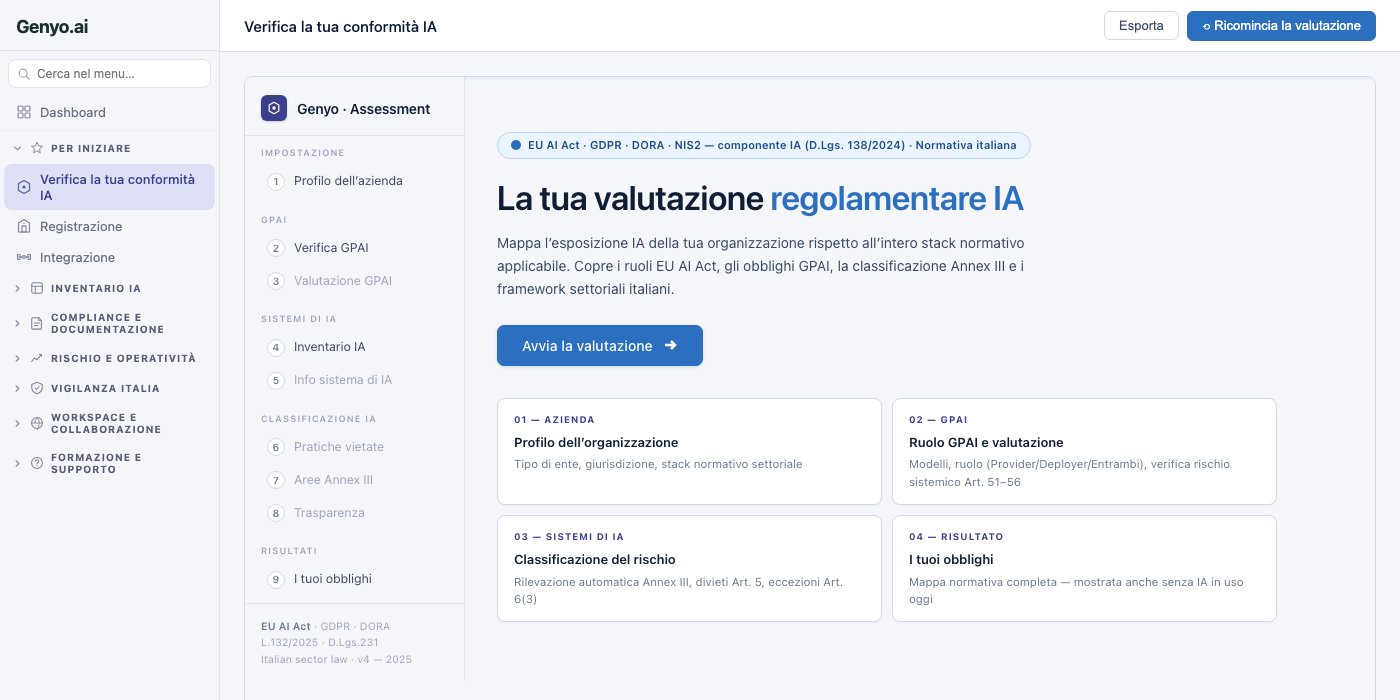
A guided questionnaire that positions the organisation against the EU AI Act, the Italian L. 132/2025 and the sector overlays that apply to it. The result is a gap list with owners, used to plan the first ninety days on the platform.
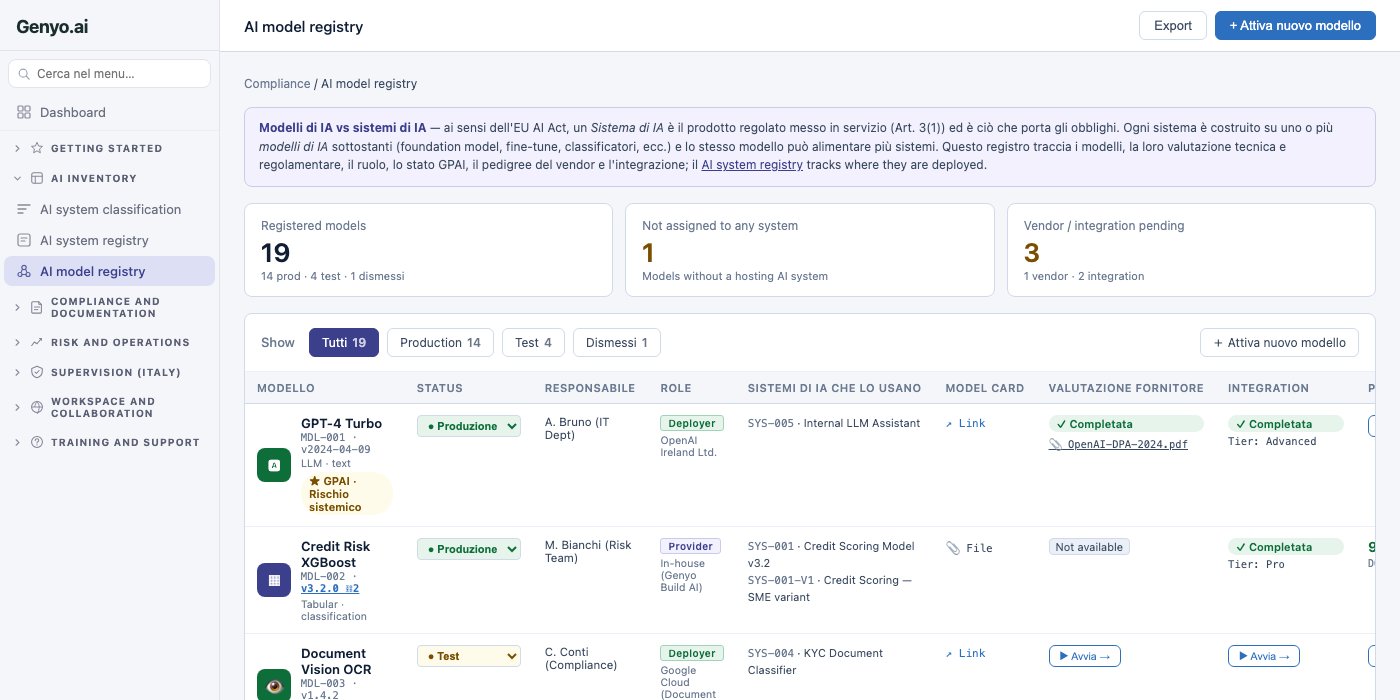
Products · AI inventory
EU AI Act Art. 11 · Annex IV §2 · Art. 51–55
The technical record of each model behind a system: architecture, training purpose, parameters, compute, capability chips and lineage — synchronised from the ML platforms rather than typed in. Feeds Annex IV §2 and the GPAI qualification.
Products · Risk and operations
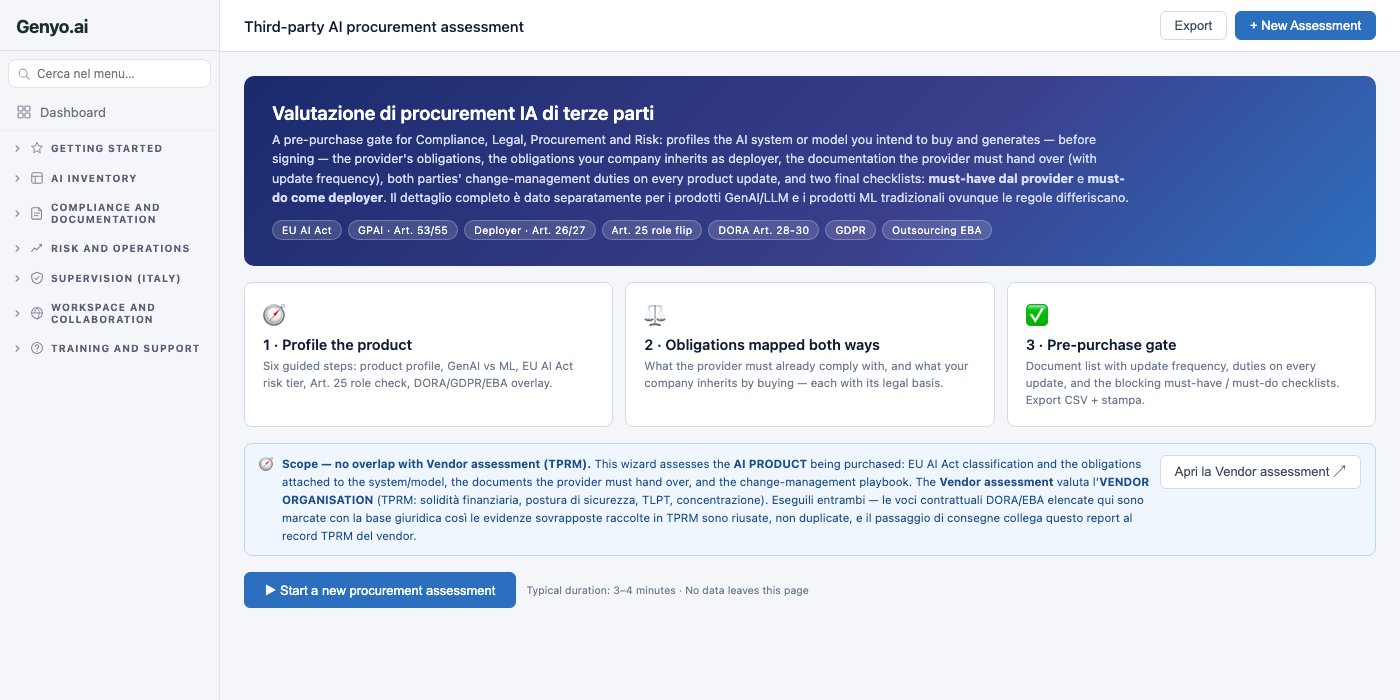
EU AI Act Art. 26 · Art. 4
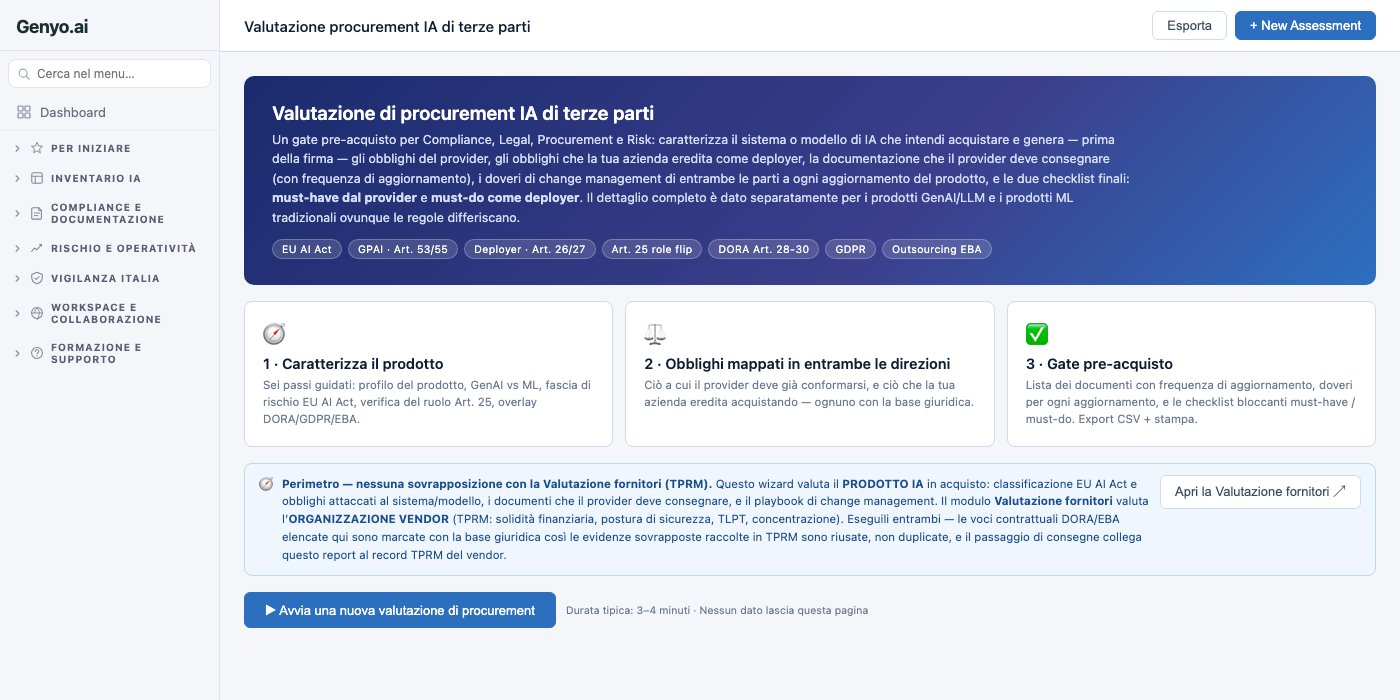
A governed channel for new AI demand: intake, function check, procurement assessment, decision, then classification into the registry. It is the structural mitigation for shadow AI — it moves demand from the unofficial channel to a governed one with a hash-chained audit trail.
Products · Supervision (Italy)
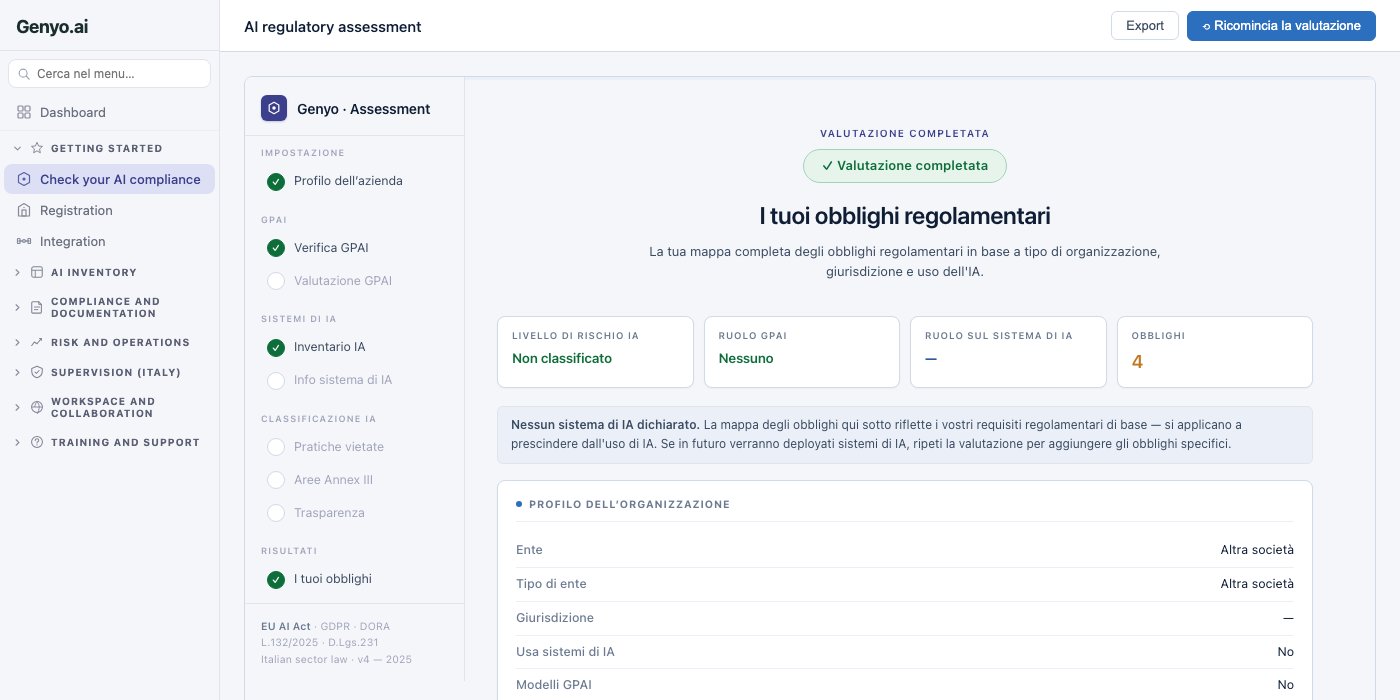
EU AI Act + L. 132/2025 + DORA · NIS2 · MiFID · Solvency II
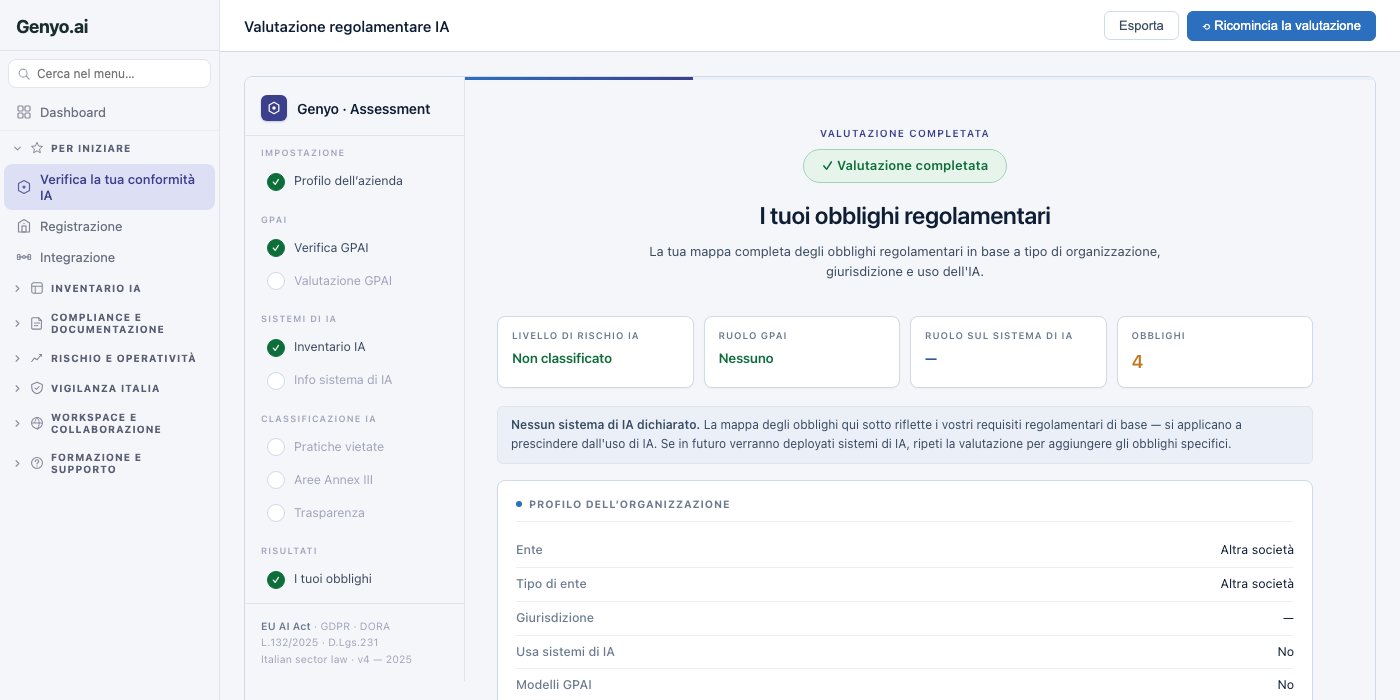
A single regulatory assessment that reads the AI Act together with the Italian L. 132/2025 and the sector law that applies to the entity — DORA, NIS2, MiFID, Solvency II — and produces the applicable obligation set for the catalogue.
Products · Risk and operations
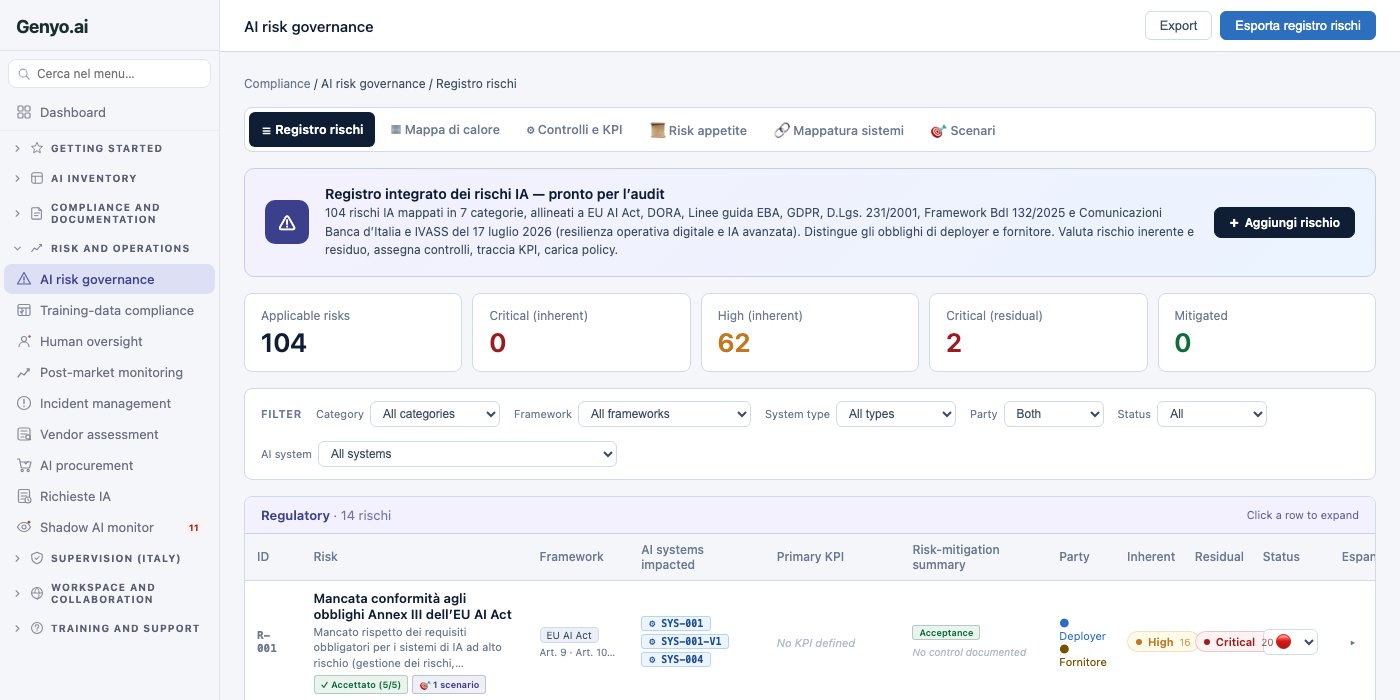
All 14 frameworks
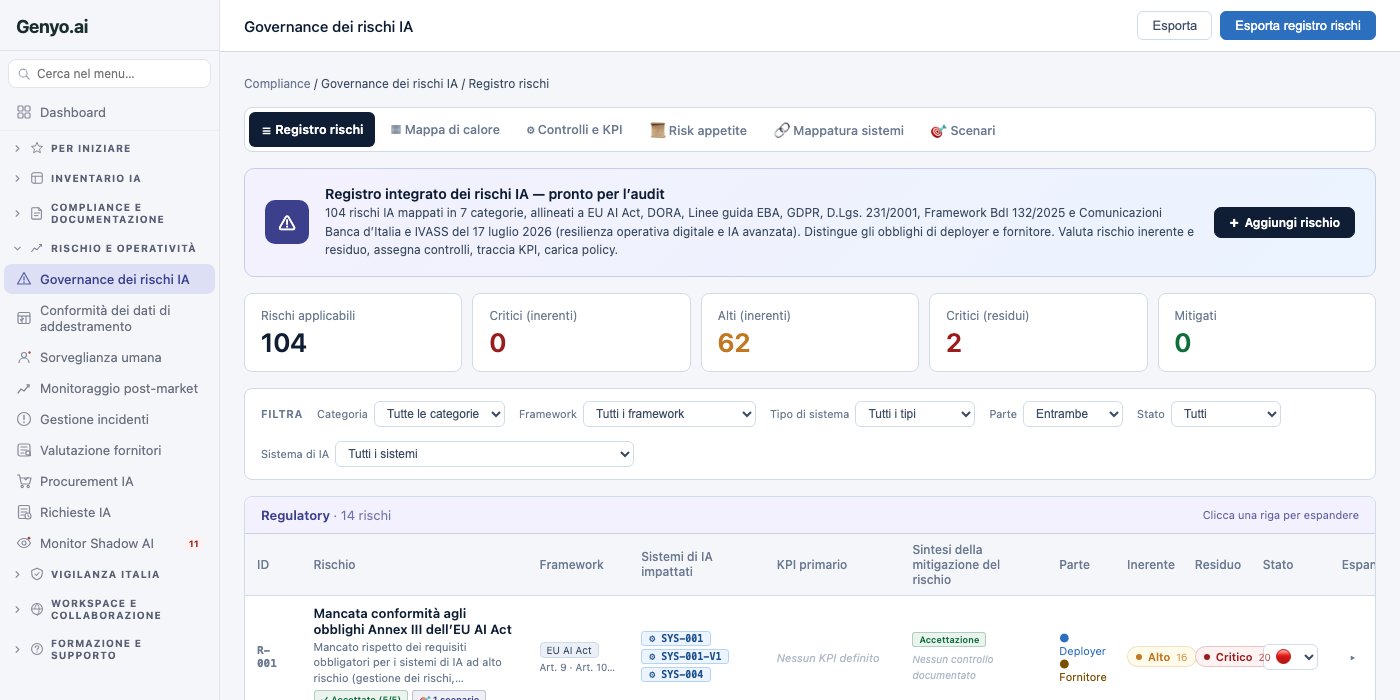
The AI risk register: 44 catalogued risks with KRI templates, sector overlays, owners and treatment plans, organised on the Banca d'Italia and IVASS risk-management communications. Every risk is linked to the obligations it threatens and the controls that mitigate it.
Products · AI inventory
EU AI Act Art. 6 + Annex III
A three-step classification that assigns the risk class of each AI system under Art. 6 and Annex III, records the reasoning, and flags the NIS2 AI-component where the entity is in scope of D.Lgs. 138/2024. The classification drives which obligations apply downstream.
Products · AI inventory
EU AI Act Art. 49 · Fw 132/2025 §5.1
The single register of every AI system the organisation provides or deploys: owner, purpose, status, entity, classification and lifecycle events. It is the source that every other module reads from, and the record that goes to the EU database under Art. 49.
Products · Compliance and documentation
EU AI Act Art. 11 · Annex IV
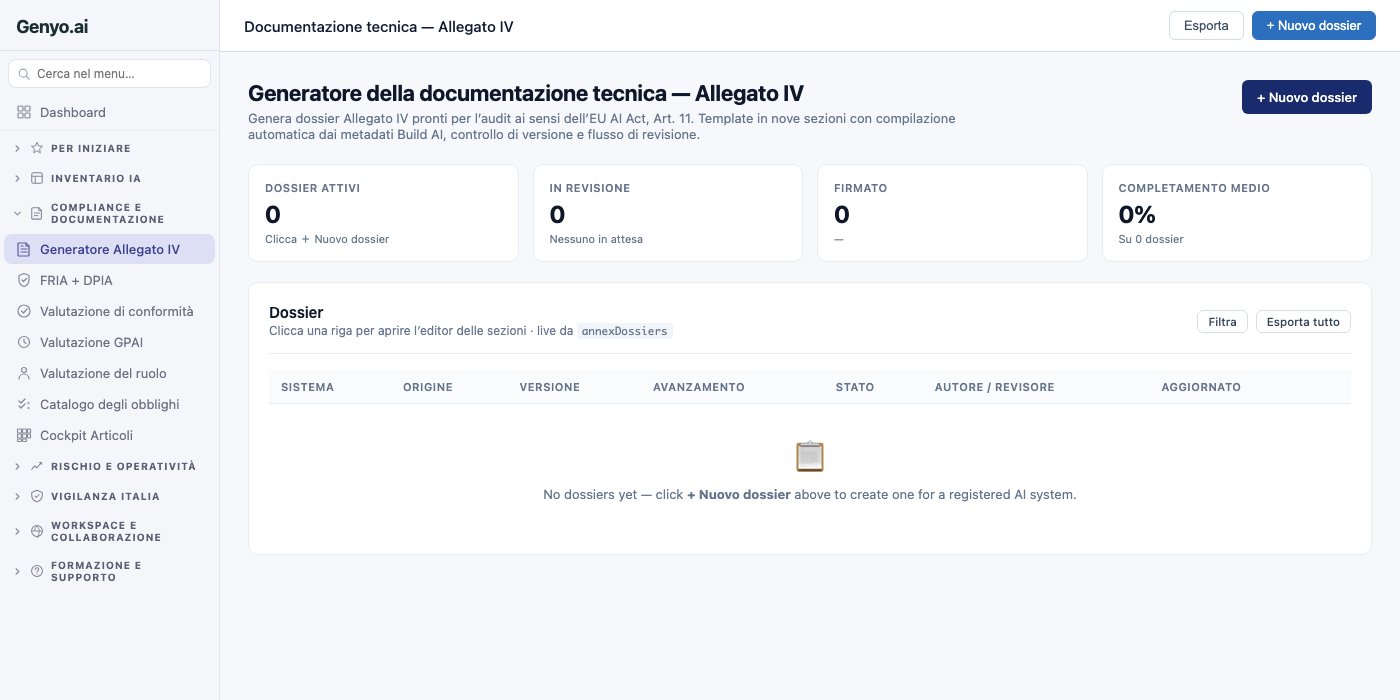
Generates the Annex IV technical documentation dossier required by Art. 11 for high-risk systems. Nine sections are pre-filled from system metadata and, for models built on Build AI, from the training pipeline itself. Version control and a review flow keep each dossier defensible.
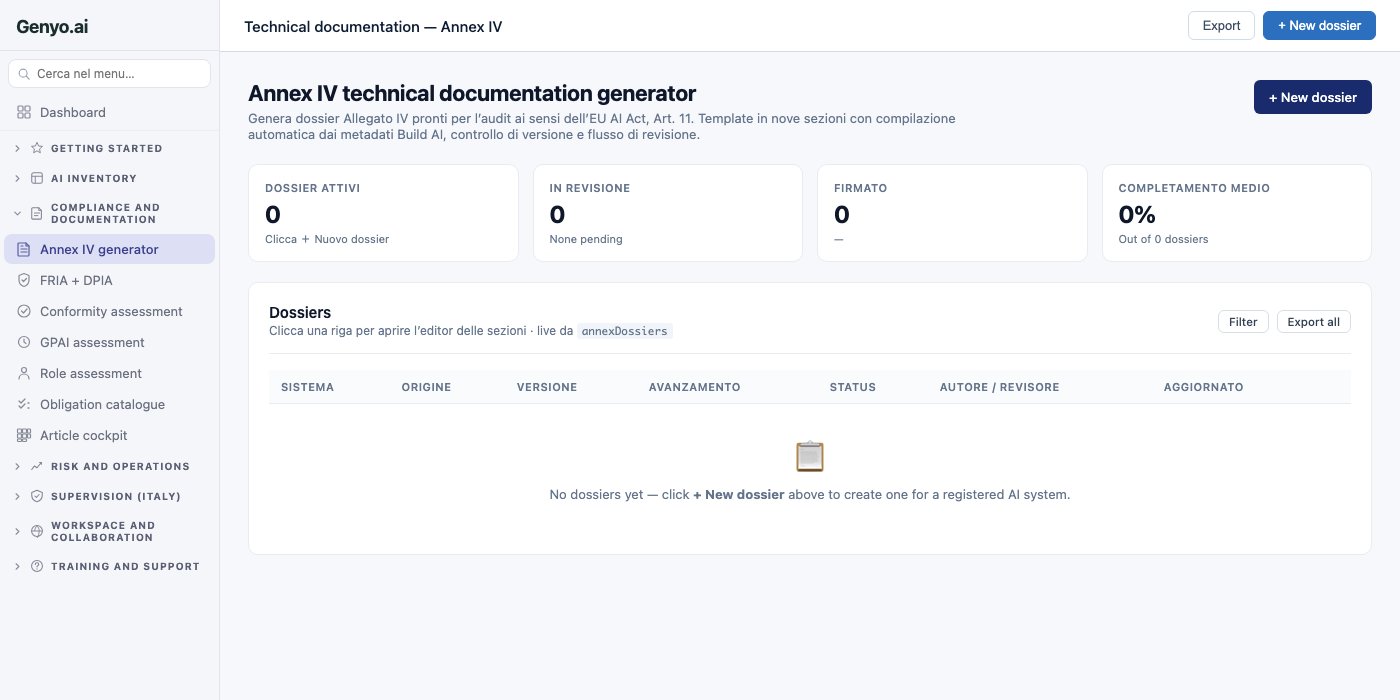
Products · Compliance and documentation
EU AI Act Ch. I–XII
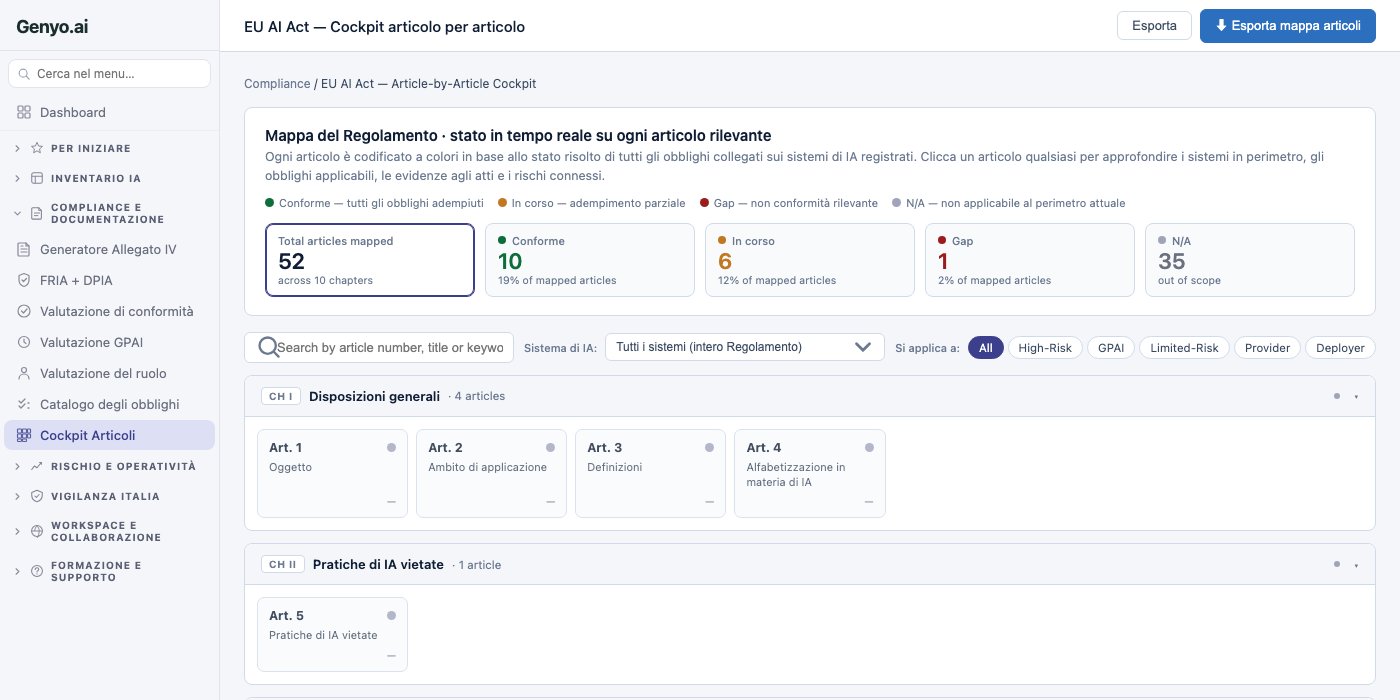
Supervisors reason by article. The cockpit shows the full structure of the AI Act, Chapters I to XII, with status, maturity and evidence against each article across all systems — the cross view you need before an inspection.
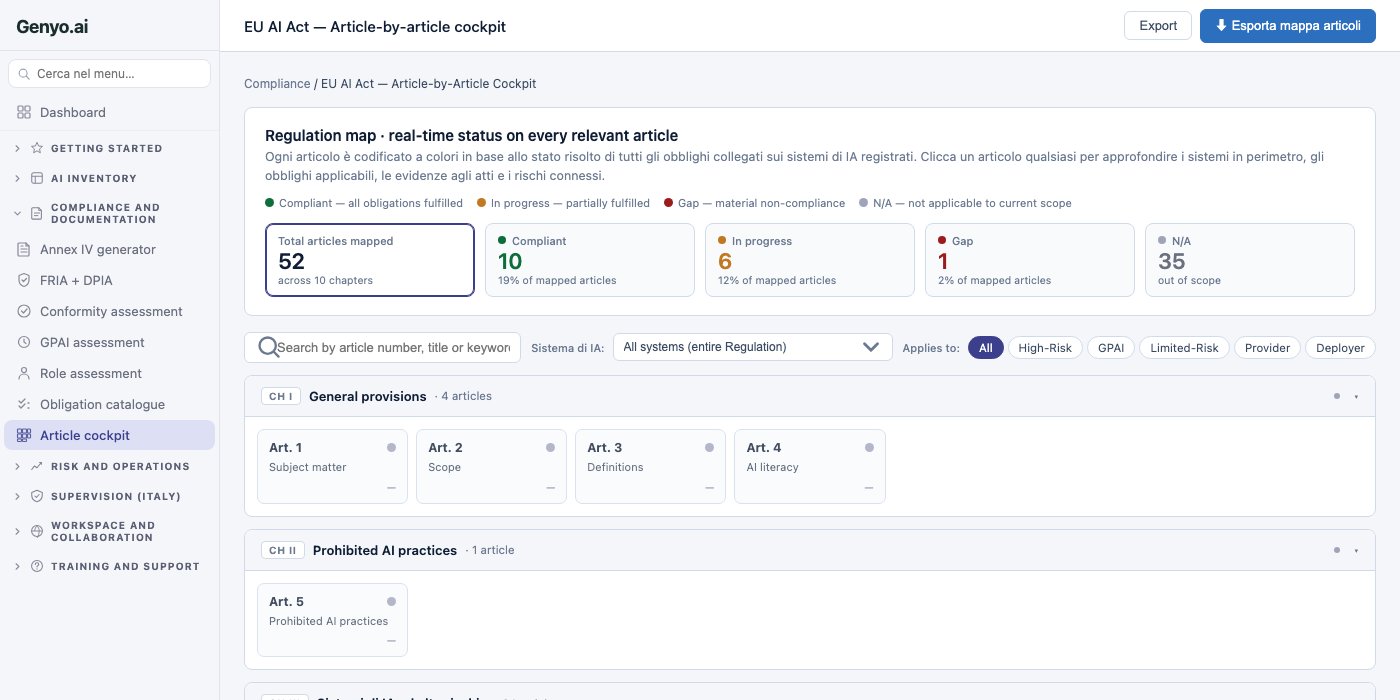
Products · Getting started
EU AI Act Art. 4 · Fw 132/2025
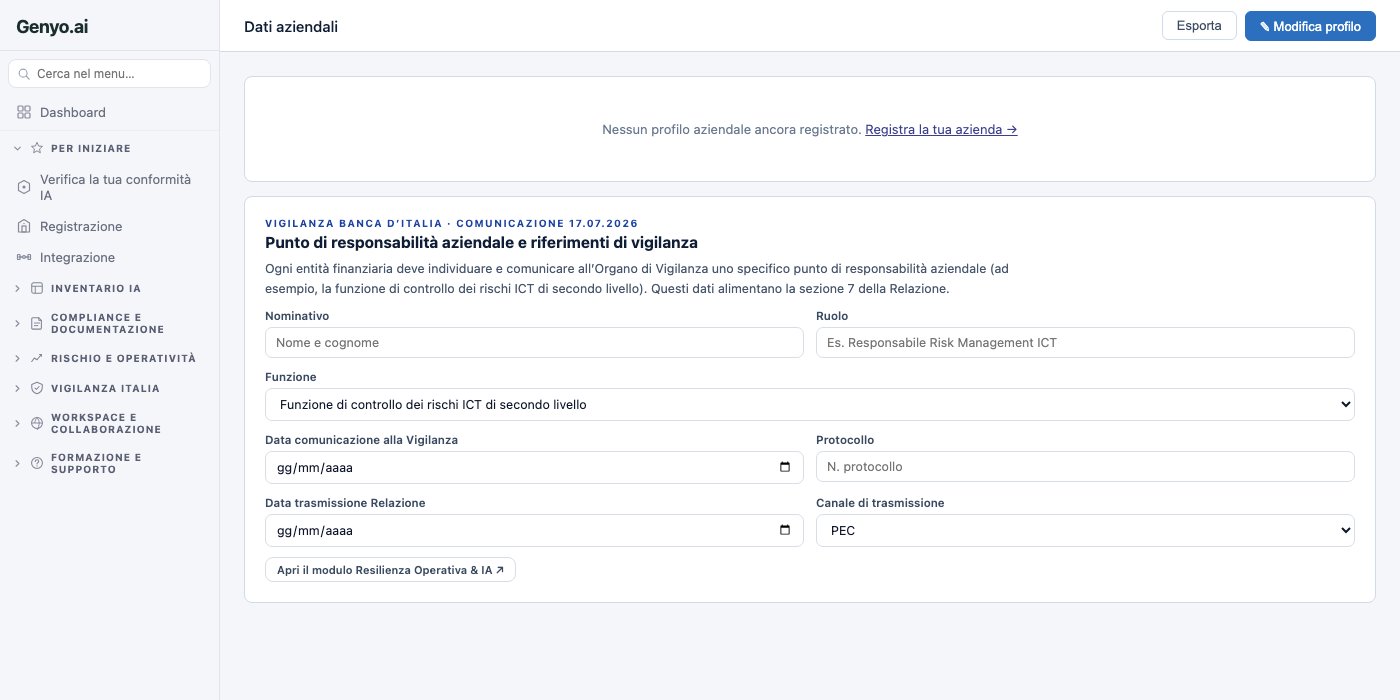
The master record for each legal entity: sector, group position, applicable overlays, escalation thresholds, board competencies and AI training carried out or planned. Every assessment and every supervisory report reads from here, so it is filled once.
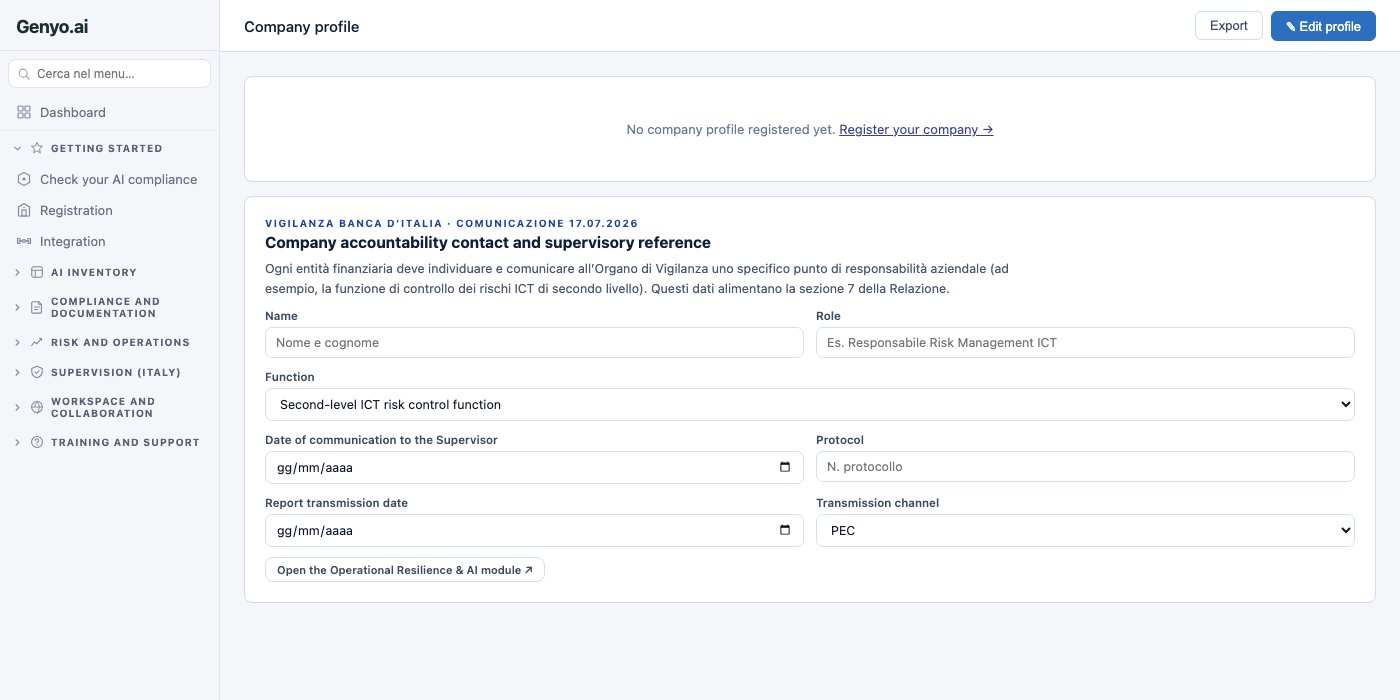
Products · Compliance and documentation
AI Act · GDPR · Data Act · DORA · NIS2
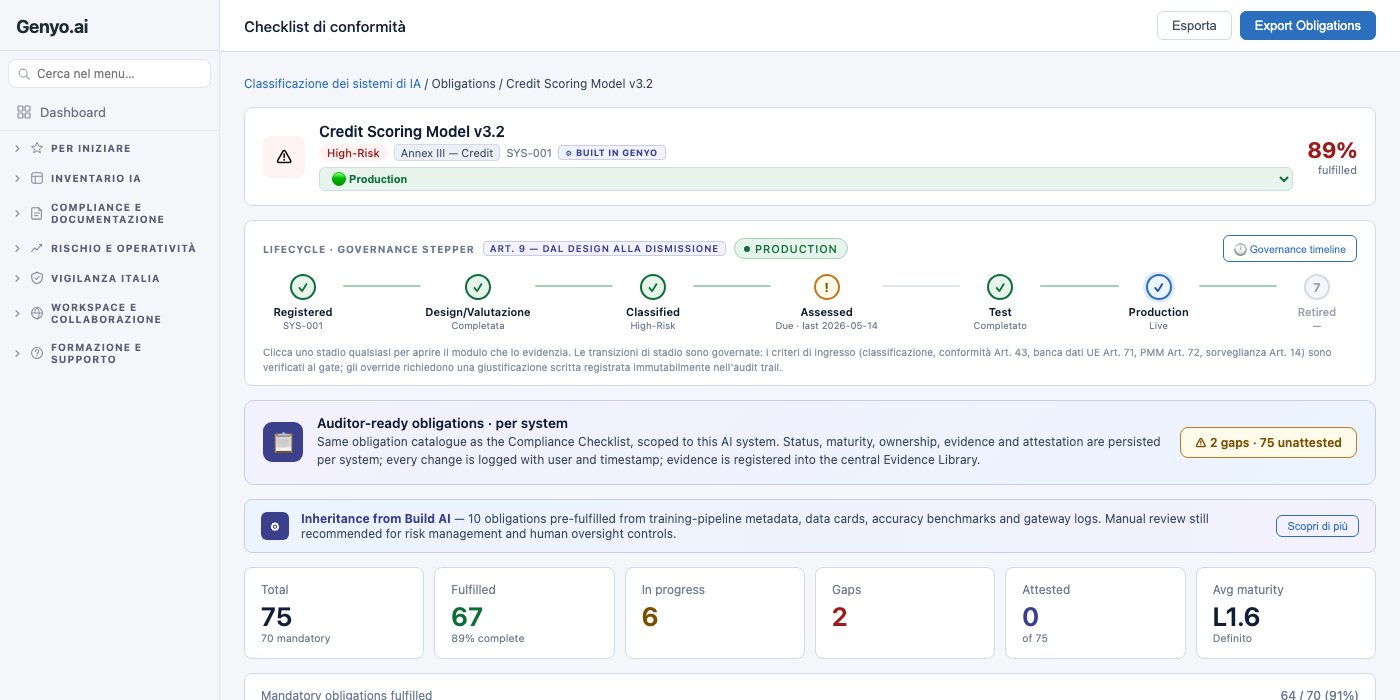
An operational checklist derived from the catalogue: the baseline that always applies, the NIS2 AI-component lens for in-scope entities, and the sector overlay — DORA and the EBA guidelines for financial services. Each item carries state, maturity and evidence.
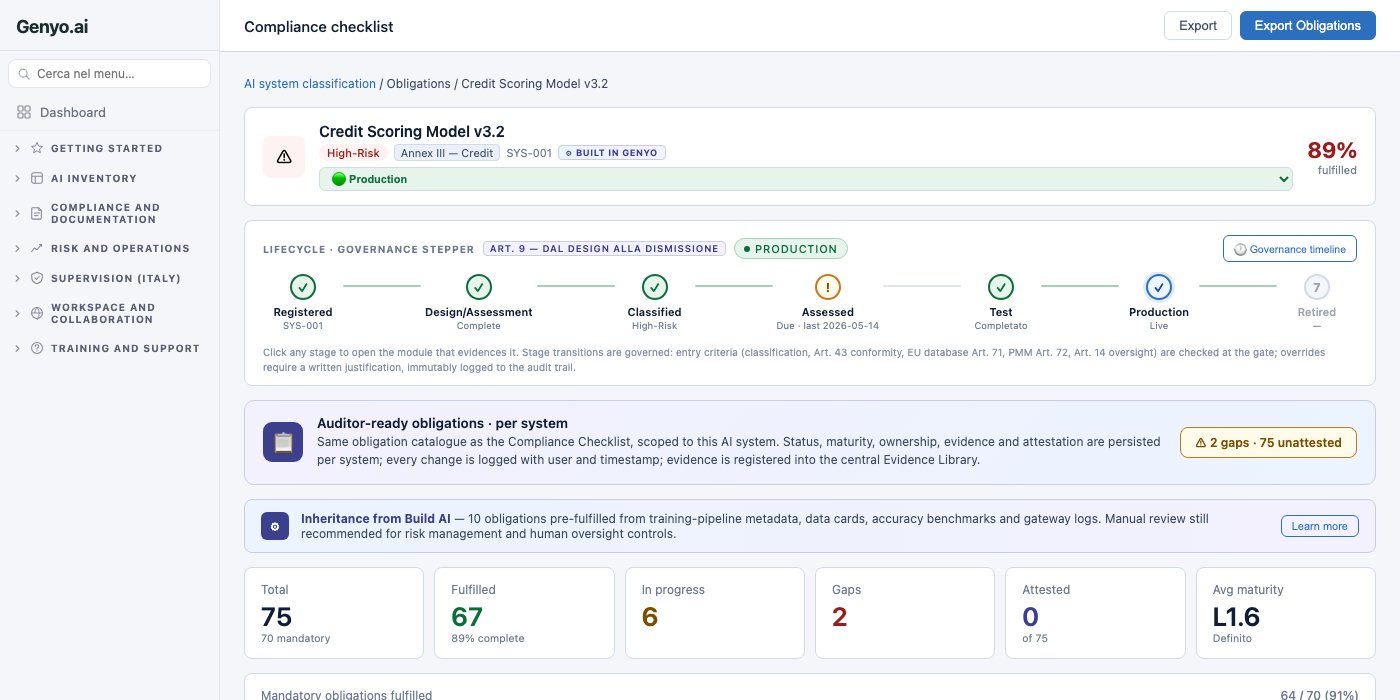
Products · Compliance and documentation
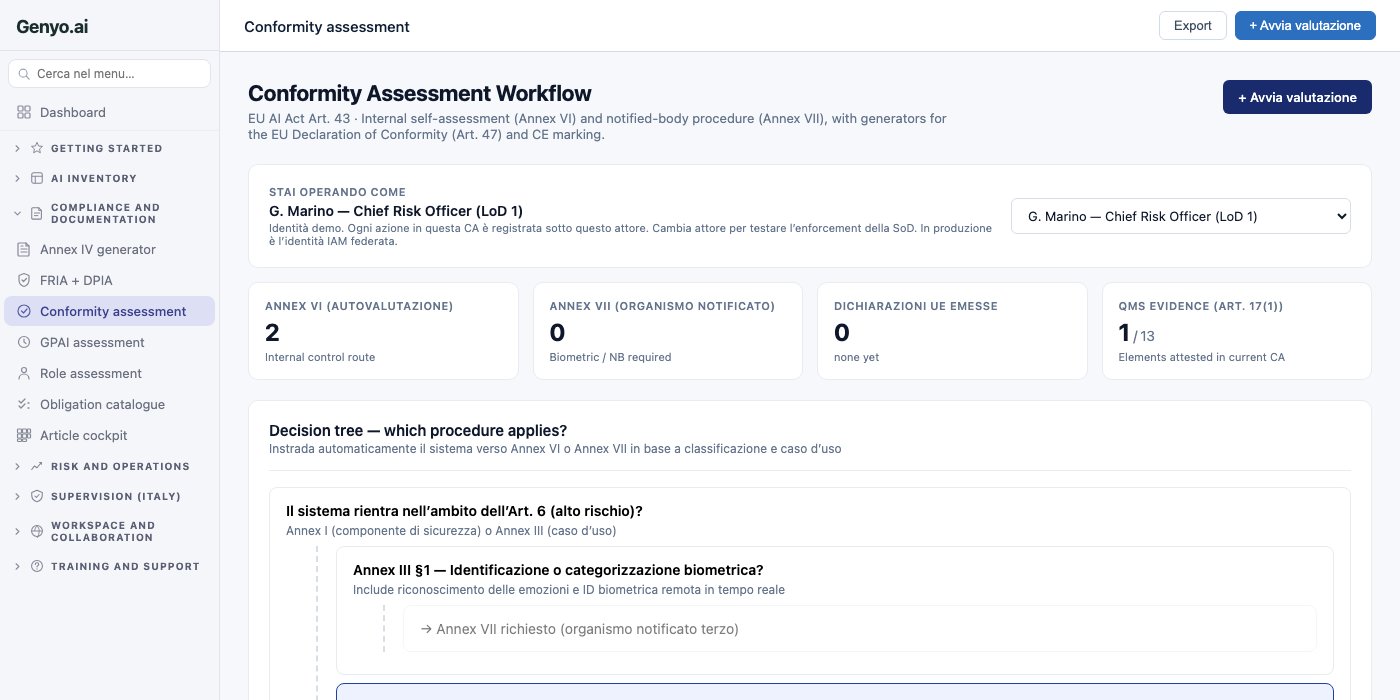
EU AI Act Art. 43 + Art. 47
Routes each high-risk system to the right procedure — Annex VI internal control for most financial-services use cases, Annex VII notified body for biometric systems — and runs it: QMS readiness, evidence matrix, completeness check, then the EU declaration of conformity and CE marking. Nine roles across the three lines of defence sign with eIDAS.
Products · Workspace, training and support
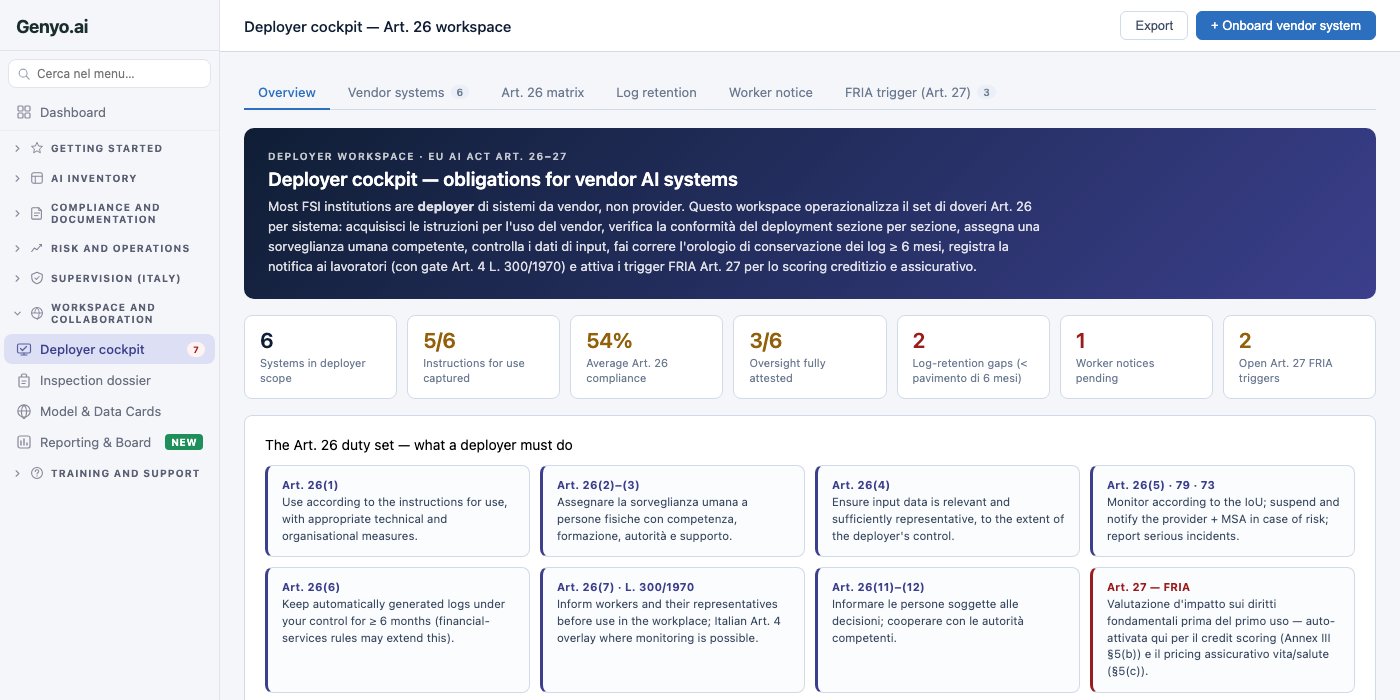
EU AI Act Art. 26
Everything a deployer owes under Art. 26 in one workspace: use according to instructions, assignment of competent human oversight, relevance of input data, monitoring of operation, log retention, information to affected persons, cooperation with authorities and the FRIA.
Products · Compliance and documentation
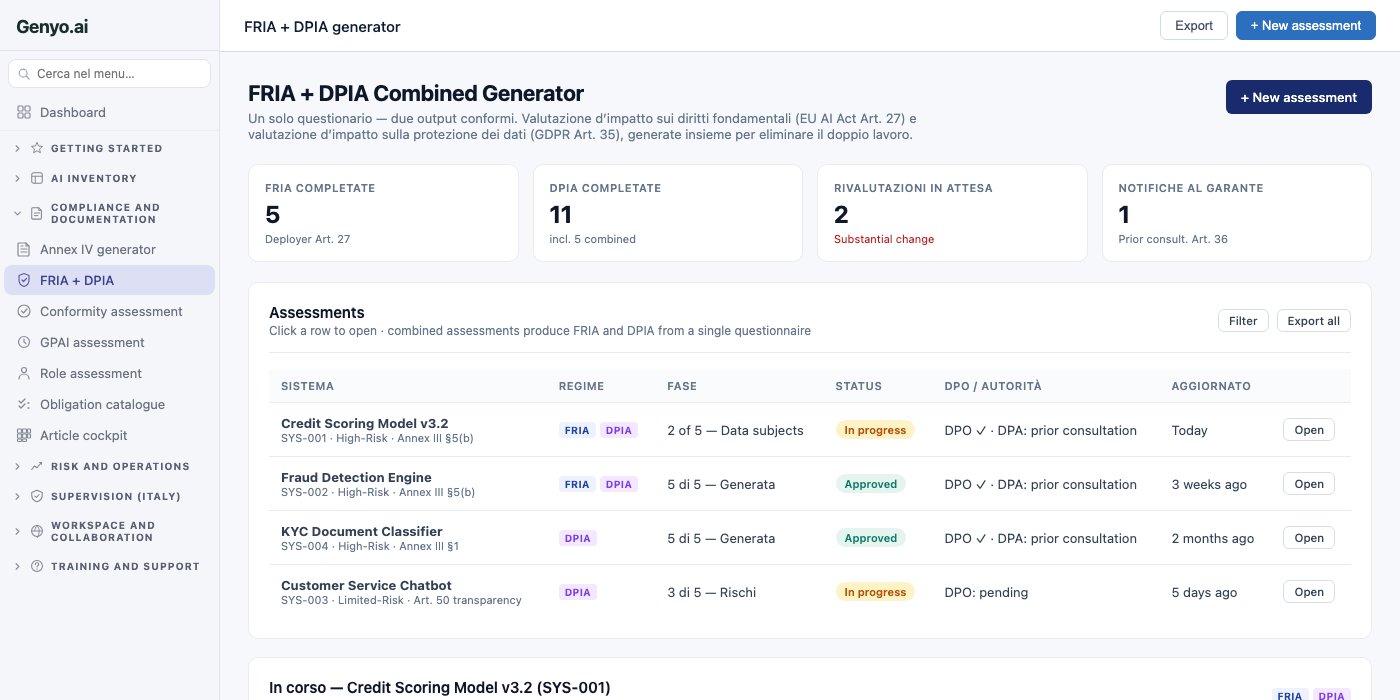
EU AI Act Art. 27 + GDPR Art. 35
The fundamental-rights impact assessment (AI Act Art. 27) and the data-protection impact assessment (GDPR Art. 35) share most of their questions. Genyo asks them once, routes the case to FRIA-only, DPIA-only or combined, and generates both documents live as you answer.
Products · Workspace, training and support
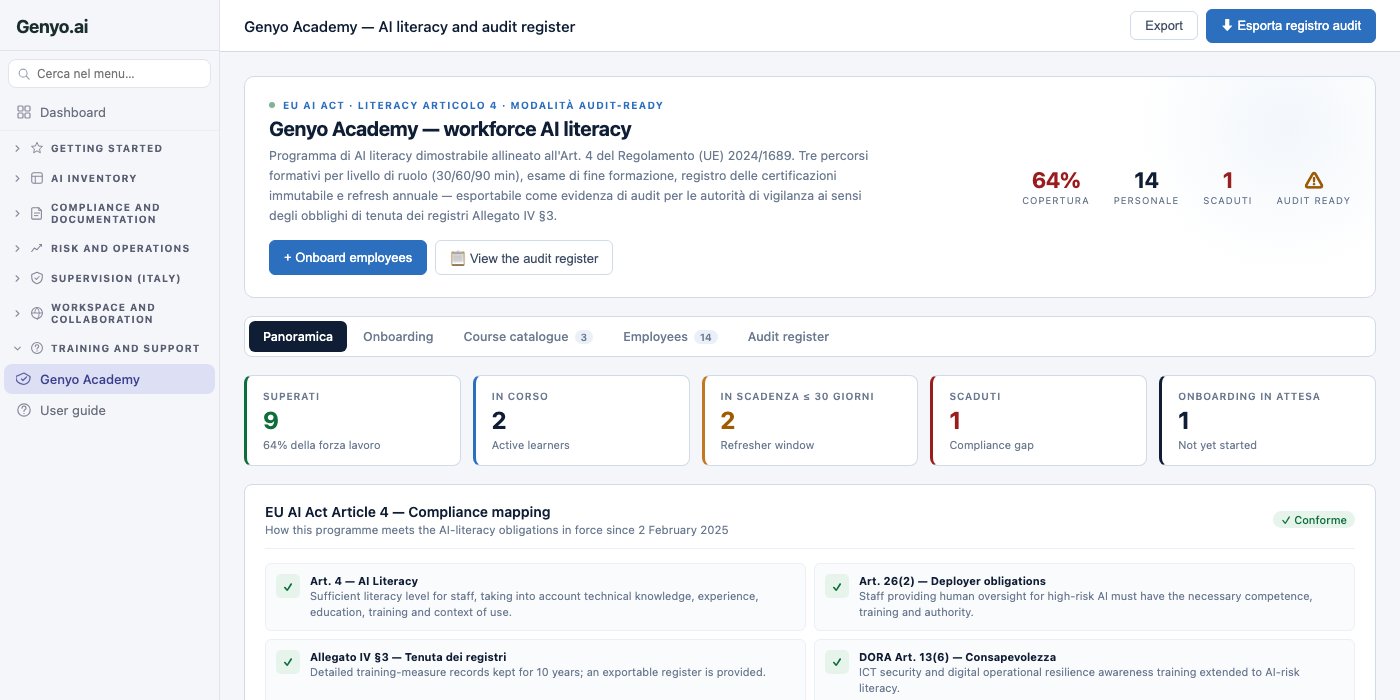
EU AI Act Art. 4 · Fw 132/2025 §9.1
The AI-literacy curriculum the AI Act requires under Art. 4, organised by role and level — from board members to model reviewers. Every completion is written to the audit register as evidence, and Academy status appears in the Vigilanza Italia report.
Products · Compliance and documentation
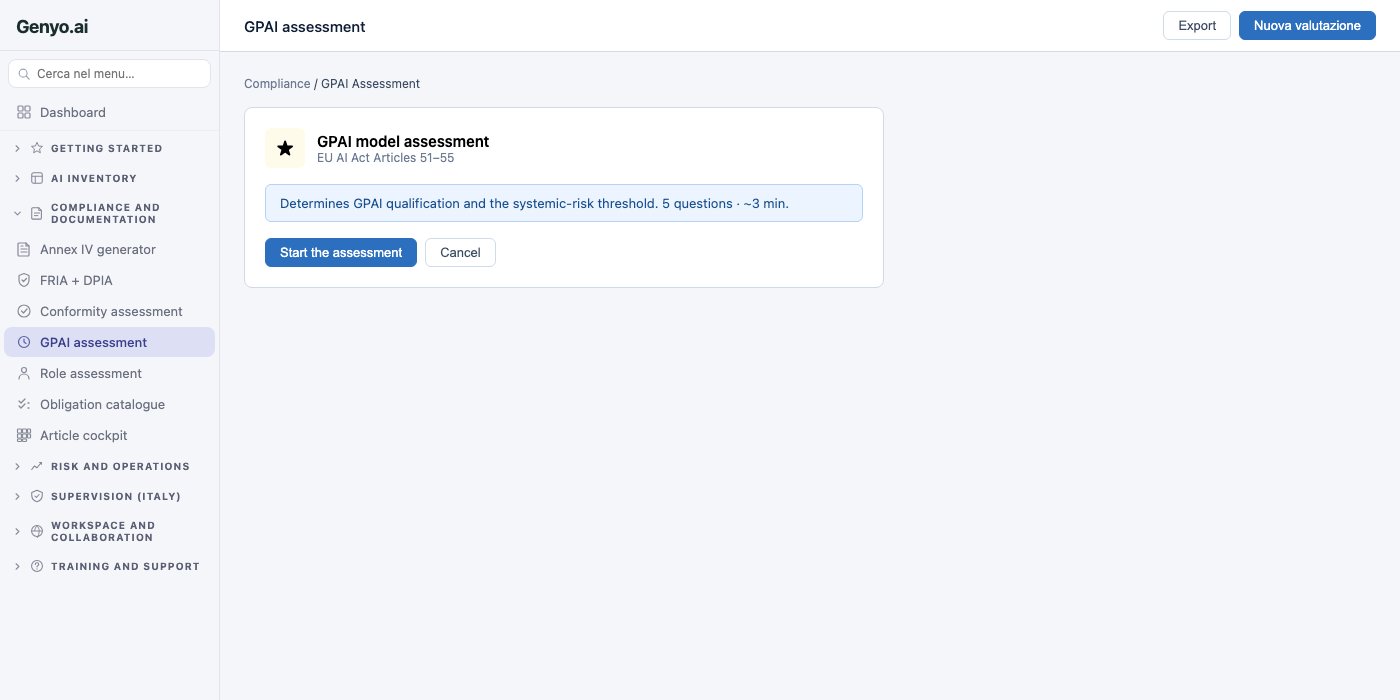
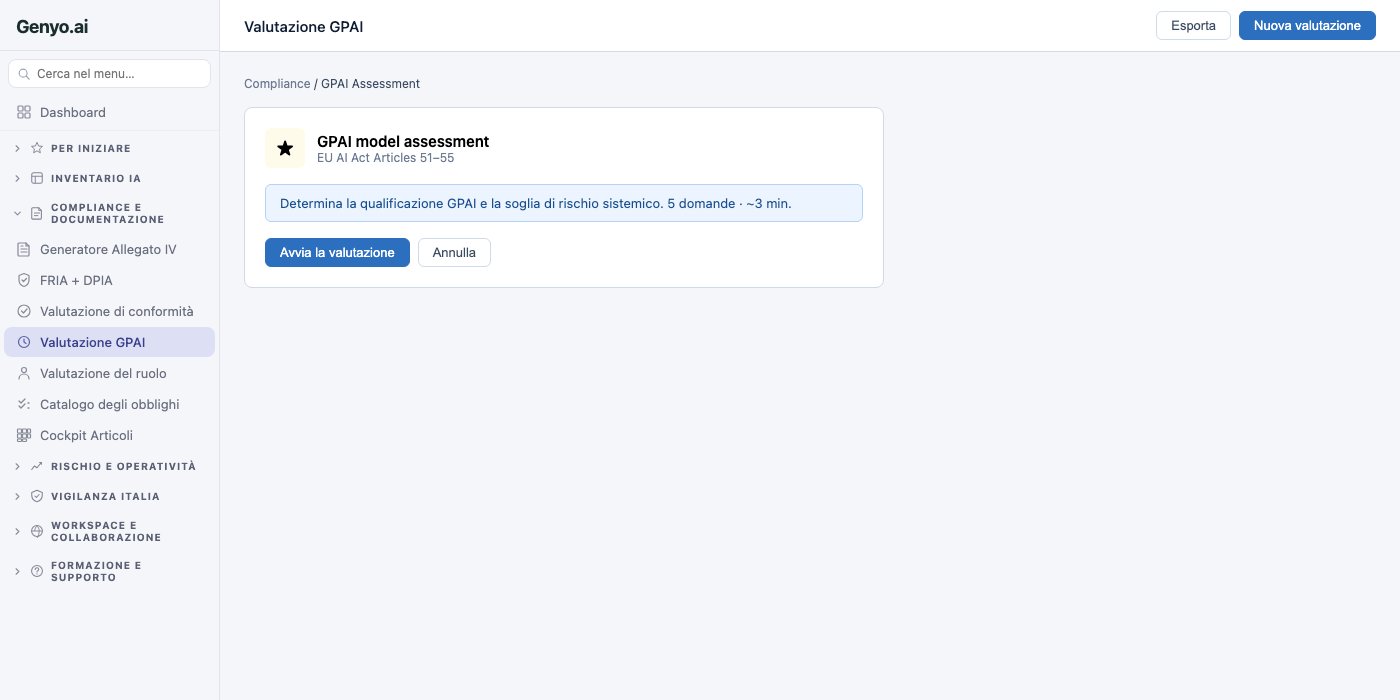
EU AI Act Art. 51–55
Determines whether a model is a general-purpose AI model, whether it carries systemic risk under the 10²⁵ FLOP threshold, and which of the Art. 53–55 obligations follow for provider and deployer. Re-runs automatically when the vendor publishes a new version.
Products · Risk and operations
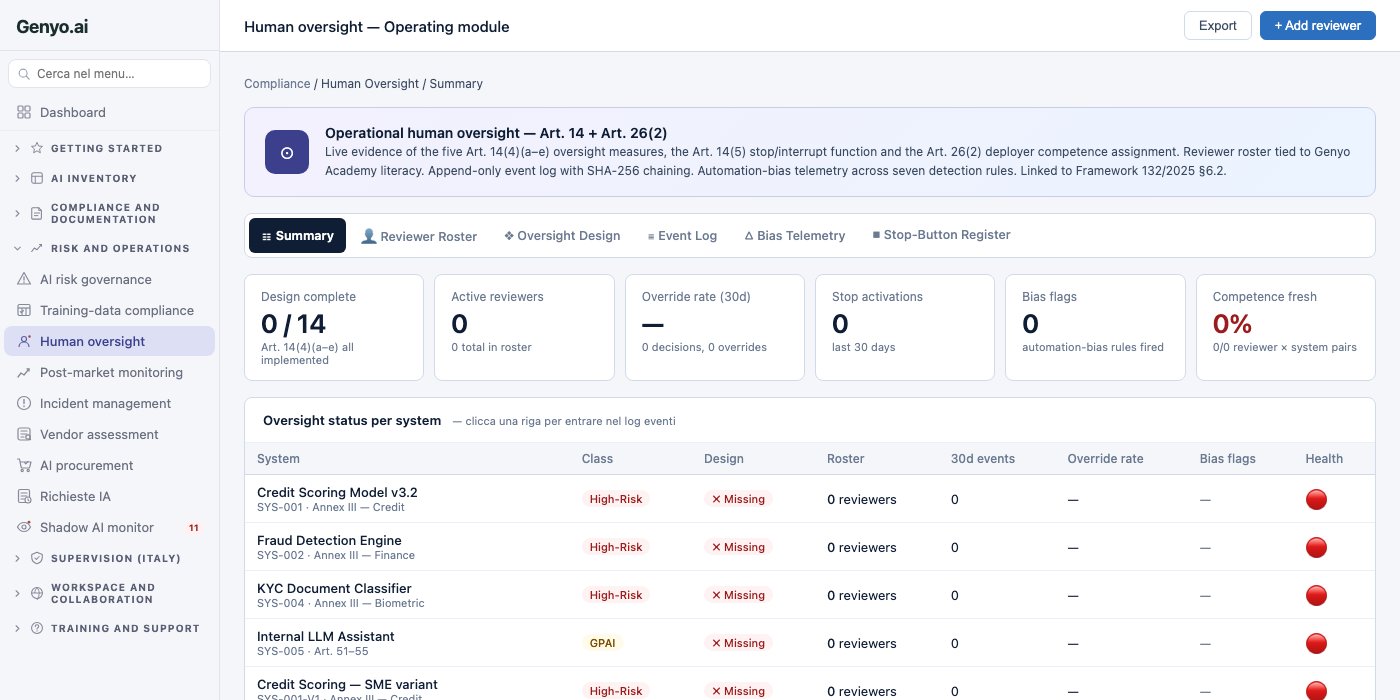
EU AI Act Art. 14 · Art. 26(2)
Designs and records the human-oversight measures required by Art. 14(4)(a–e) for each high-risk system, and the deployer's assignment of competent oversight under Art. 26(2). The design auto-populates Annex IV §2(e).
Products · Risk and operations
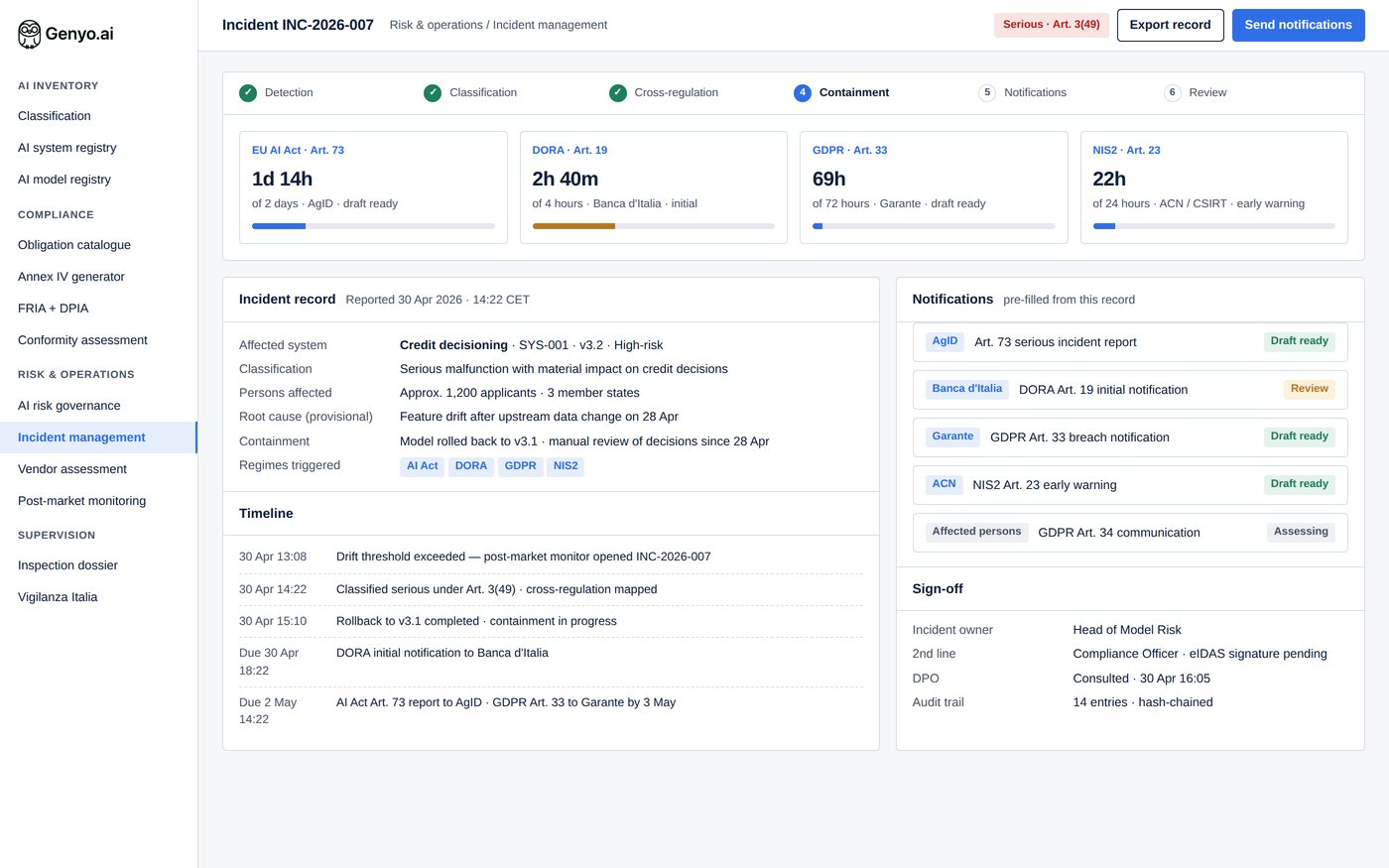
EU AI Act Art. 73 + DORA Art. 19 + GDPR Art. 33 + NIS2 Art. 23
Report a serious incident once. Genyo classifies its severity, works out which other regimes it triggers, starts every clock, and pre-fills each authority's notification from the same record — AgID under the AI Act, Banca d'Italia under DORA, the Garante under GDPR, ACN under NIS2.
Products · Workspace, training and support
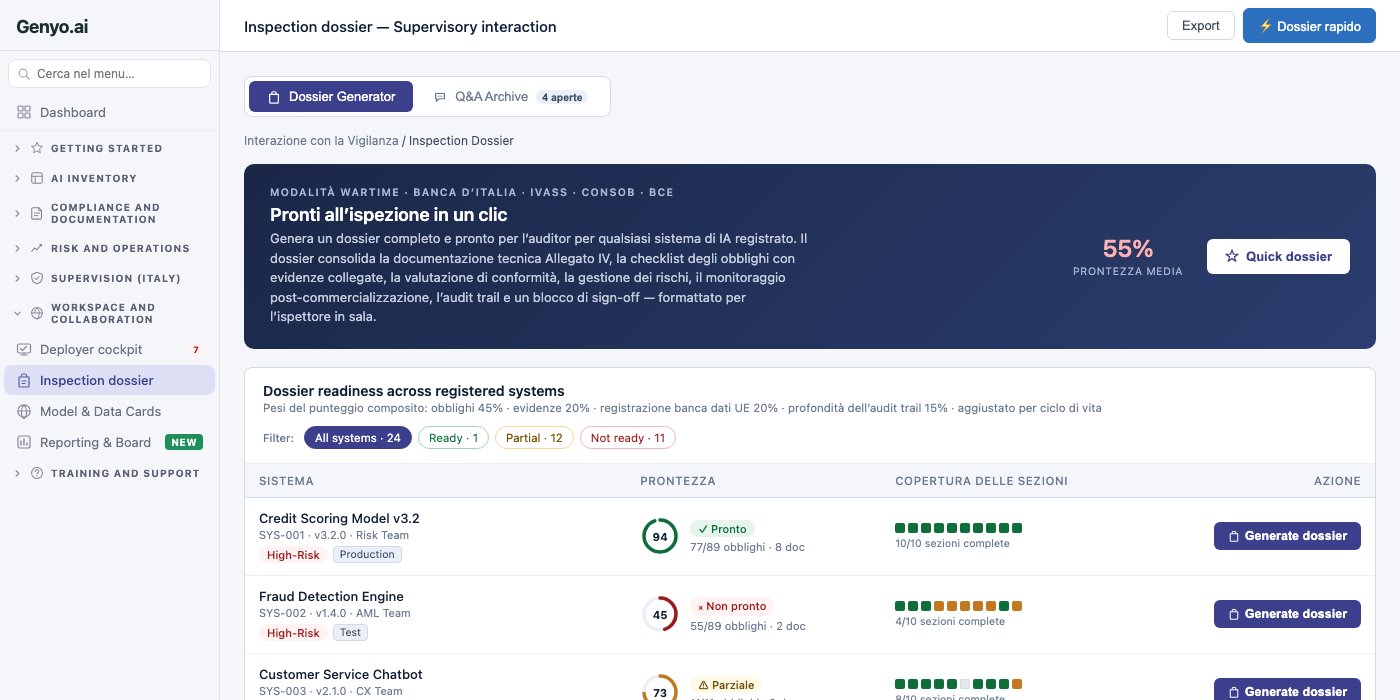
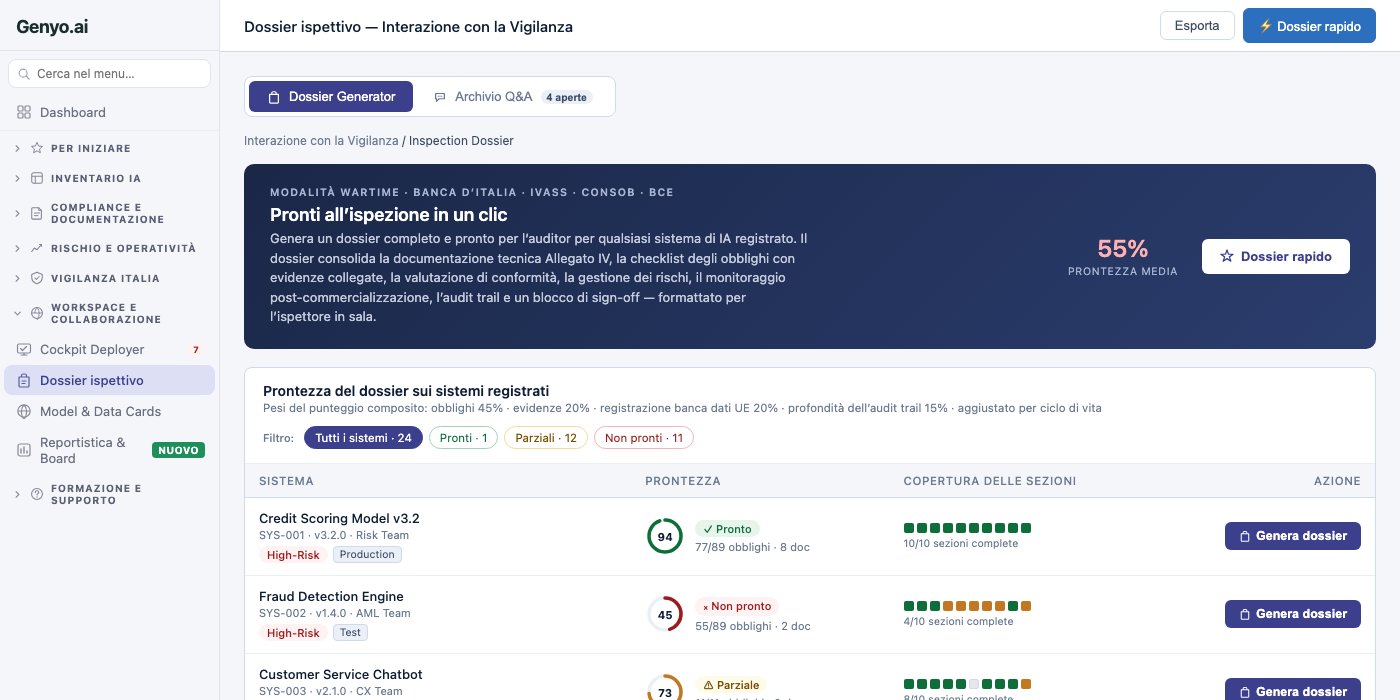
All supervisors
Assembles the package a supervisor asks for — registers, classifications, assessments, evidence, audit ledger — in the order they read it, and tracks their questions and your answers during the inspection. Covers financial-services supervisors, utilities regulators and NIS2 authorities.
Products · Getting started
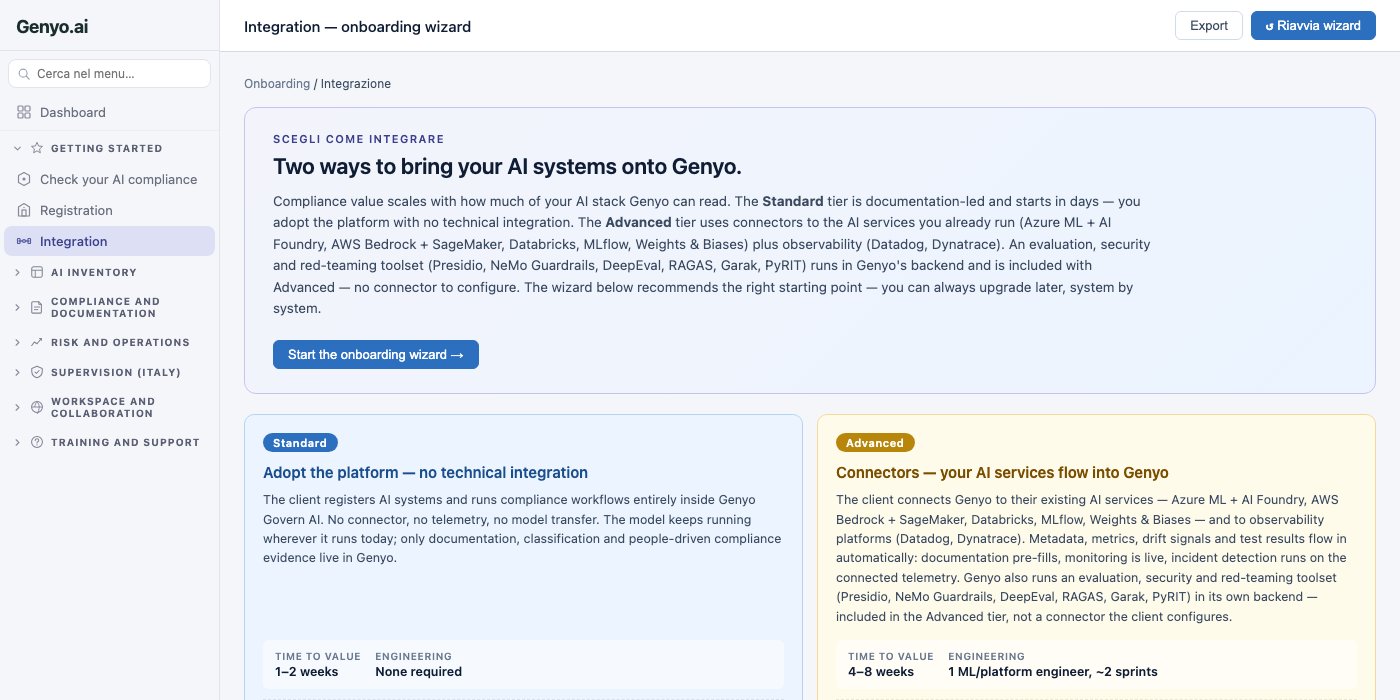
Product configuration
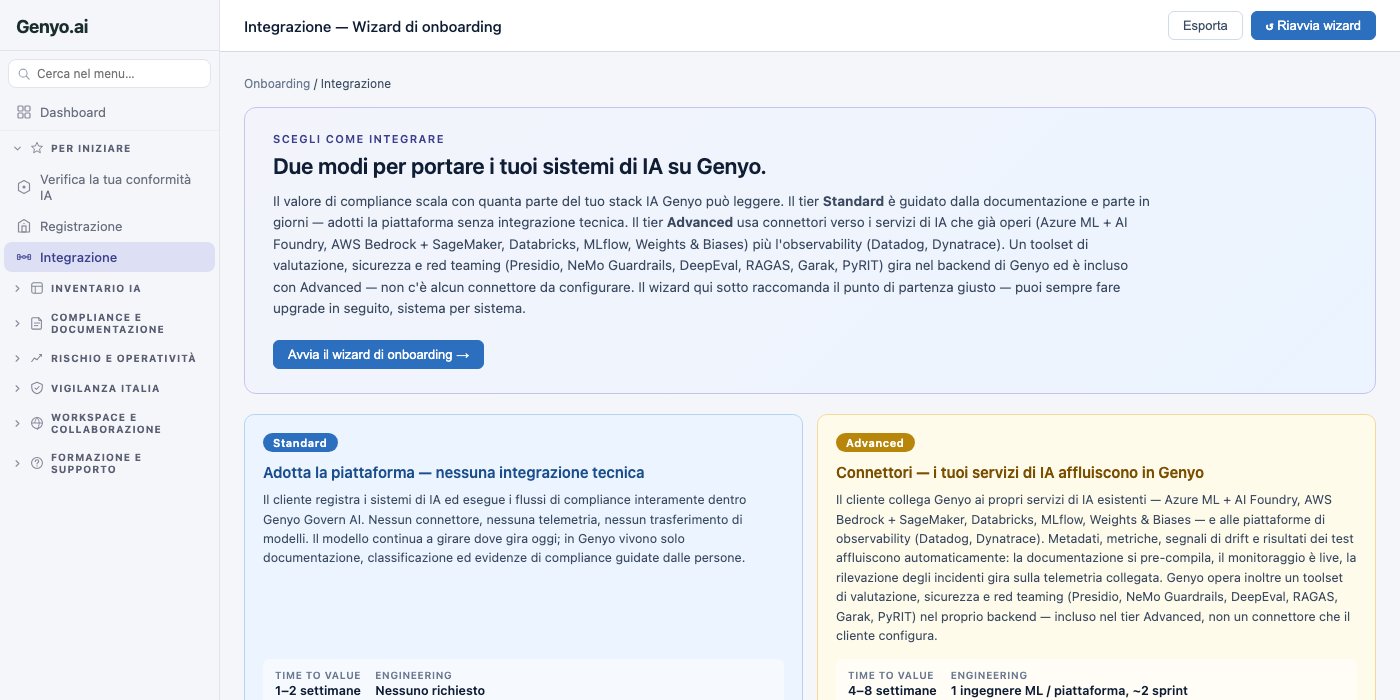
A step-by-step wizard for each connector: what it feeds, which credentials it needs (always read-only), and what happens on the first sync. Model registries, run metrics, deployment metadata and security signals land in the evidence base without re-keying.
Products · Workspace, training and support
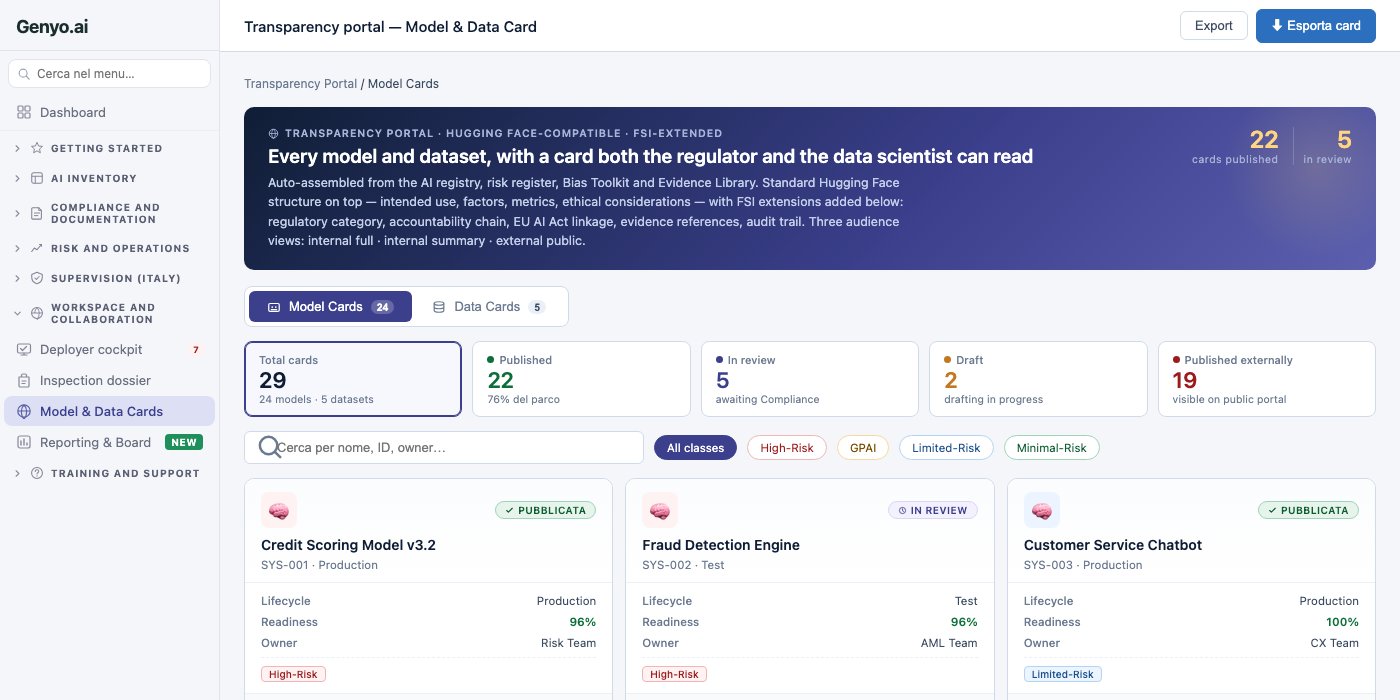
Annex IV §2 · GDPR Art. 30 · Fw 132/2025 §6.1
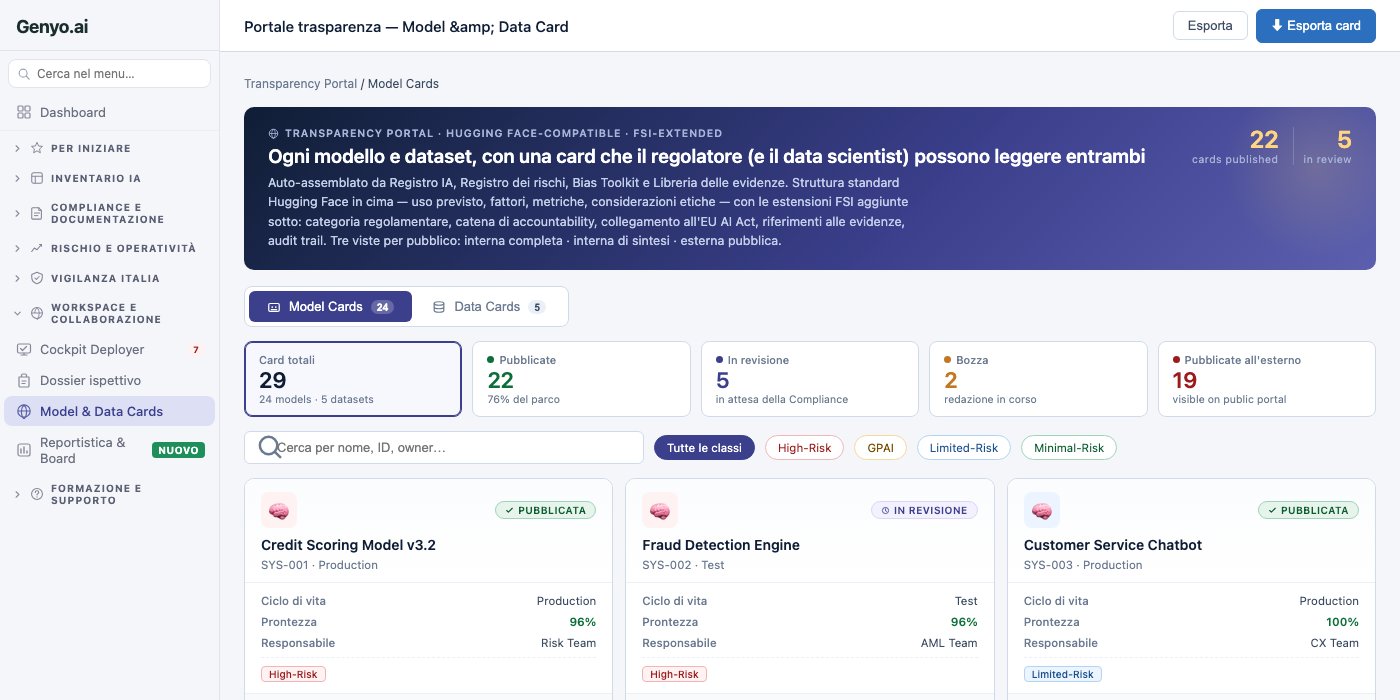
A transparency card per model that reviewers, auditors and — where required — affected persons can read: purpose, architecture, data, limitations, oversight, and the GDPR Art. 30 record of processing. Reviewers see the card before a decision.
Products · Compliance and documentation
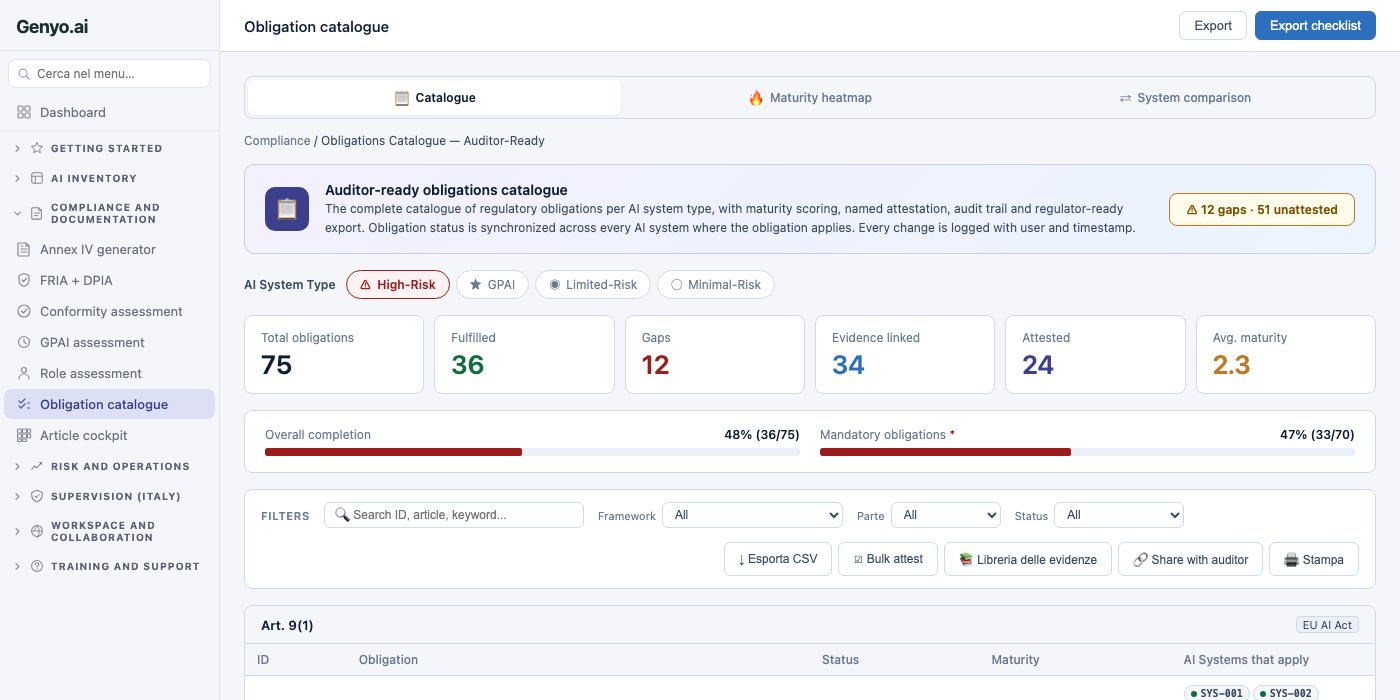
14 frameworks
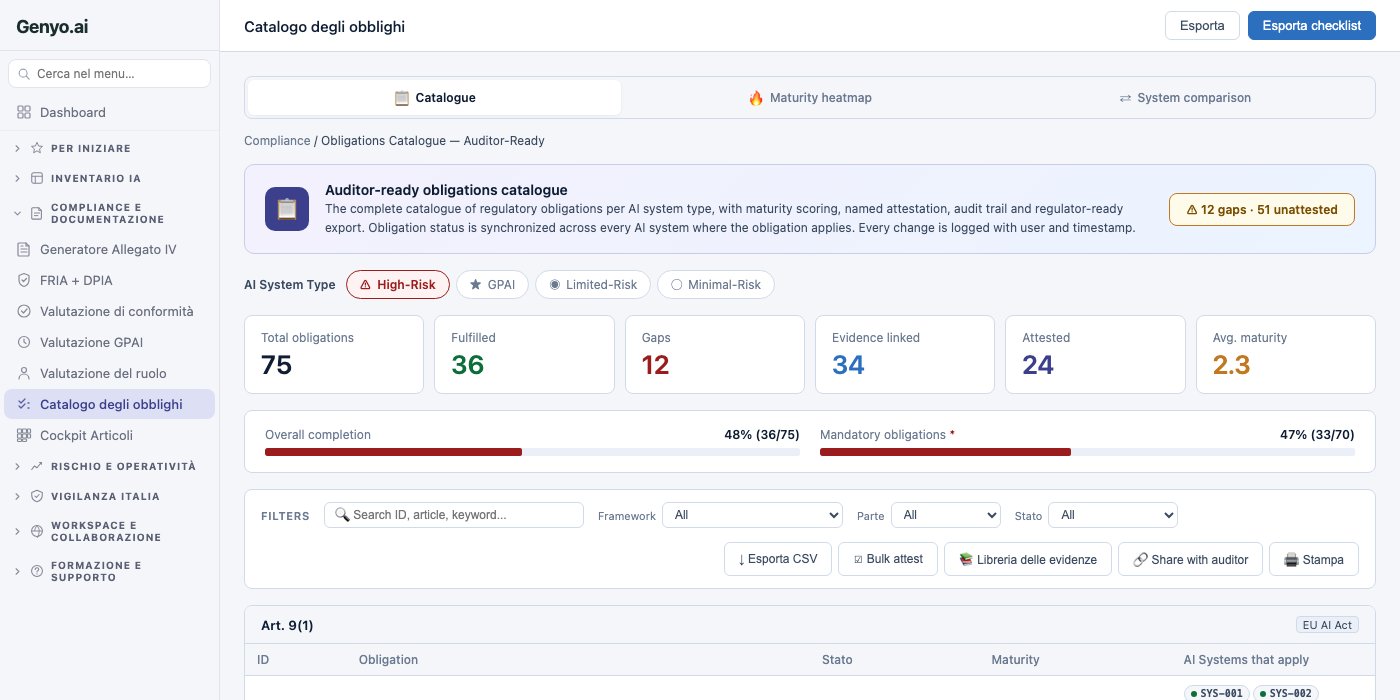
Where regulation becomes work. 135 obligations across 14 frameworks, each with an owner, a status, a maturity level and links to the evidence that satisfies it. The cross-cutting baseline (AI Act, GDPR, Data Act) applies always; sector and NIS2 overlays switch on per entity.
Products · Risk and operations
EU AI Act Art. 72
Builds the post-market monitoring plan required by Art. 72: metrics detected from the connected platforms, thresholds, reporting cadence and the triggers that open an incident. Drift beyond tolerance becomes an incident record automatically.
Products · Compliance and documentation
EU AI Act Art. 25–27
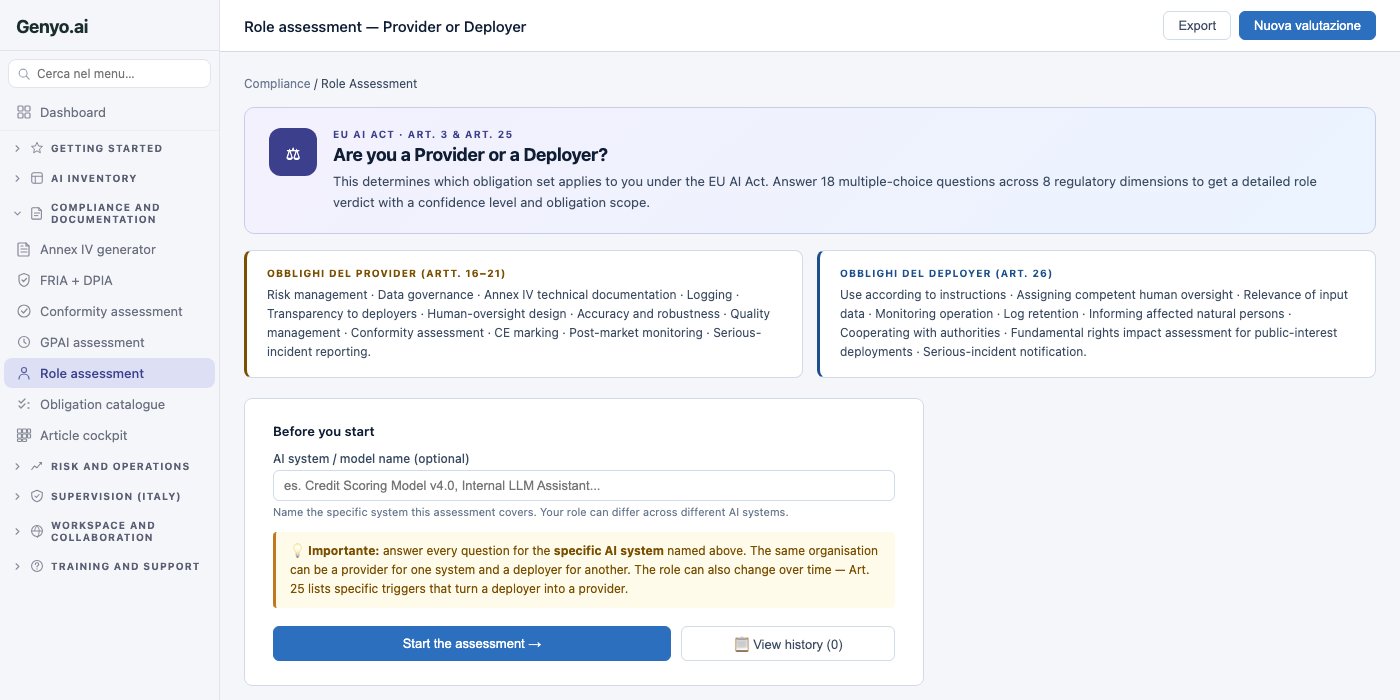
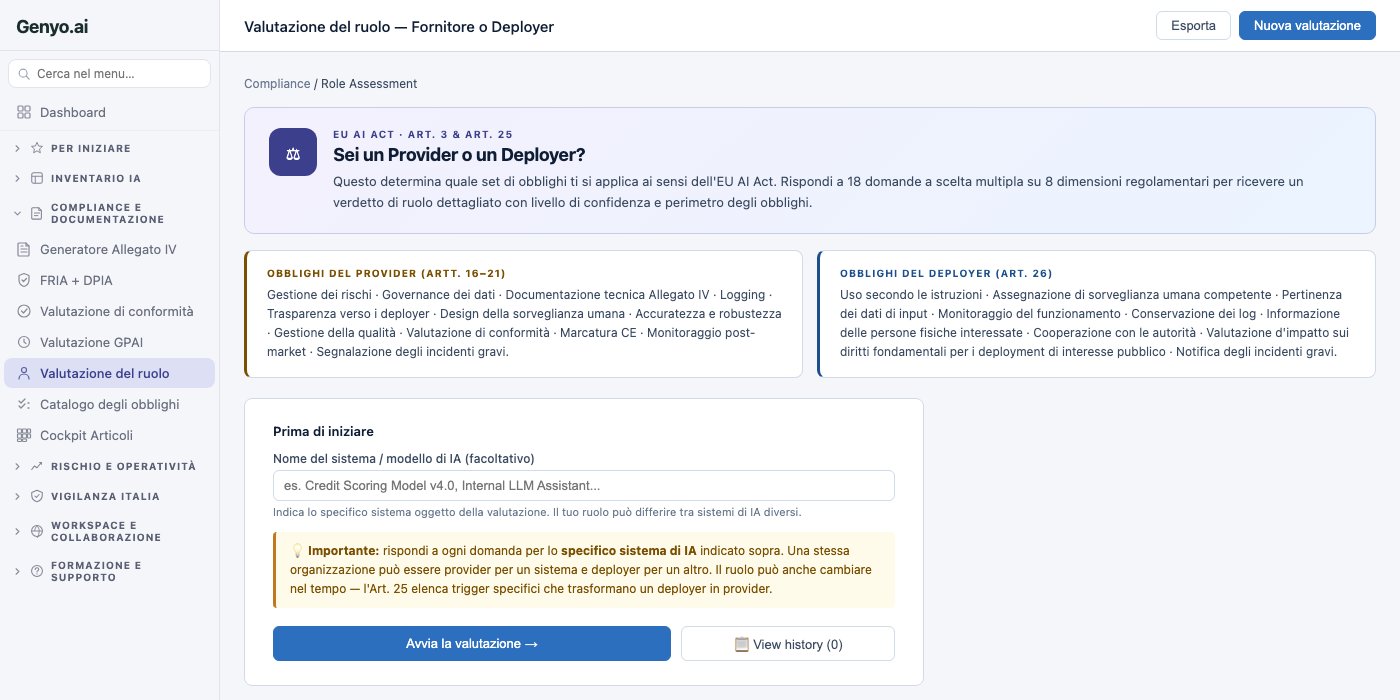
Under Art. 3 and Art. 25, the role you hold for each model determines which obligations you carry. The wizard settles provider versus deployer per model and per service, lists the Art. 9–17 obligations that follow, and produces the contractual clauses and the Annex IV or Annex VIII registration that apply.
Products · Risk and operations
EU AI Act Art. 4 · Art. 26 · L. 300/1970 Art. 4
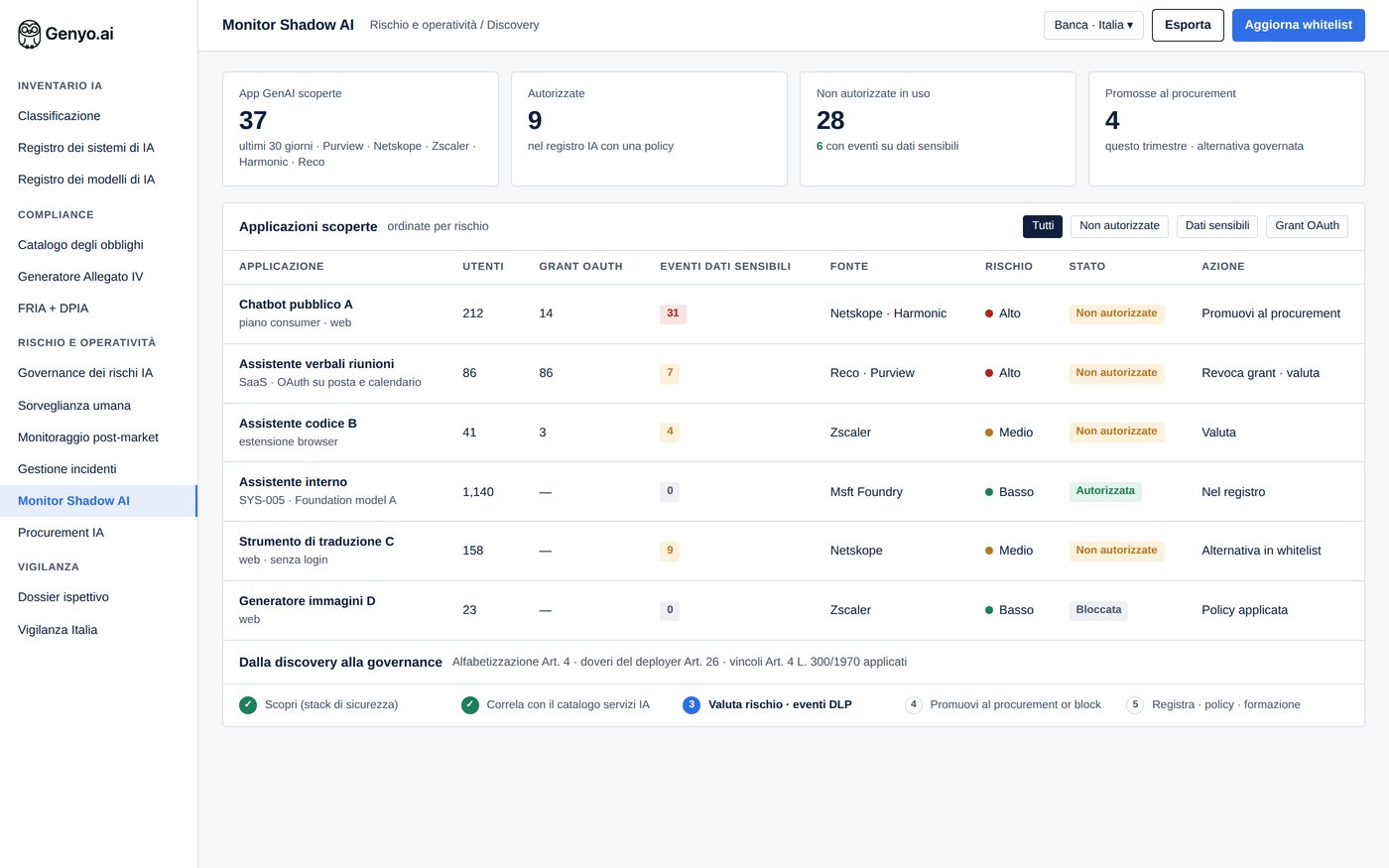
Reads the inventory of GenAI applications discovered by your security stack — Purview, Netskope, Zscaler, Harmonic Security, Reco — with risk scores, OAuth grants and sensitive-data exposure events, and correlates them with the AI service catalogue. Relevant tools are promoted to the registry; DLP events can open incidents.
Products · Risk and operations
EU AI Act Art. 10
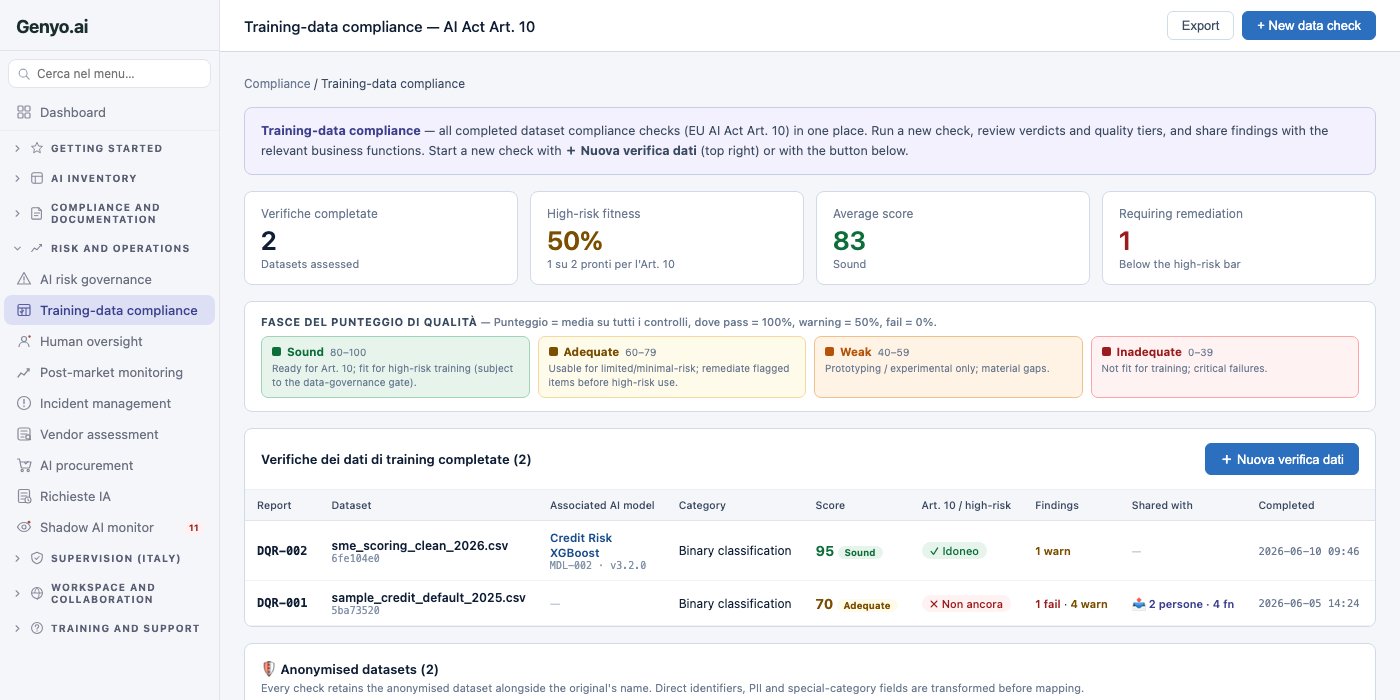
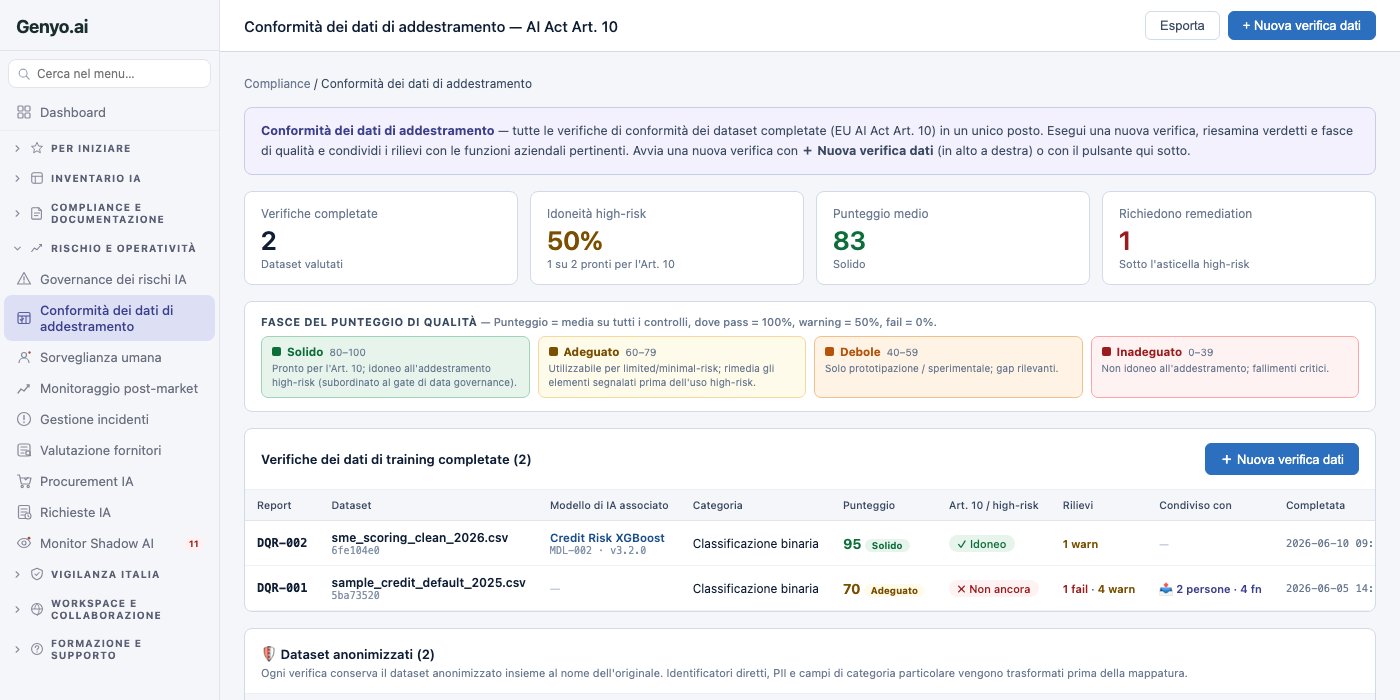
Tests whether a dataset meets the Art. 10 requirements on data governance, relevance, representativeness and bias examination before training starts. The verdict and quality band are stored with the model and reused in Annex IV.
Products · Risk and operations
DORA Art. 28 · EBA GL/2022/05 · AI Act Art. 11 · GDPR Art. 28
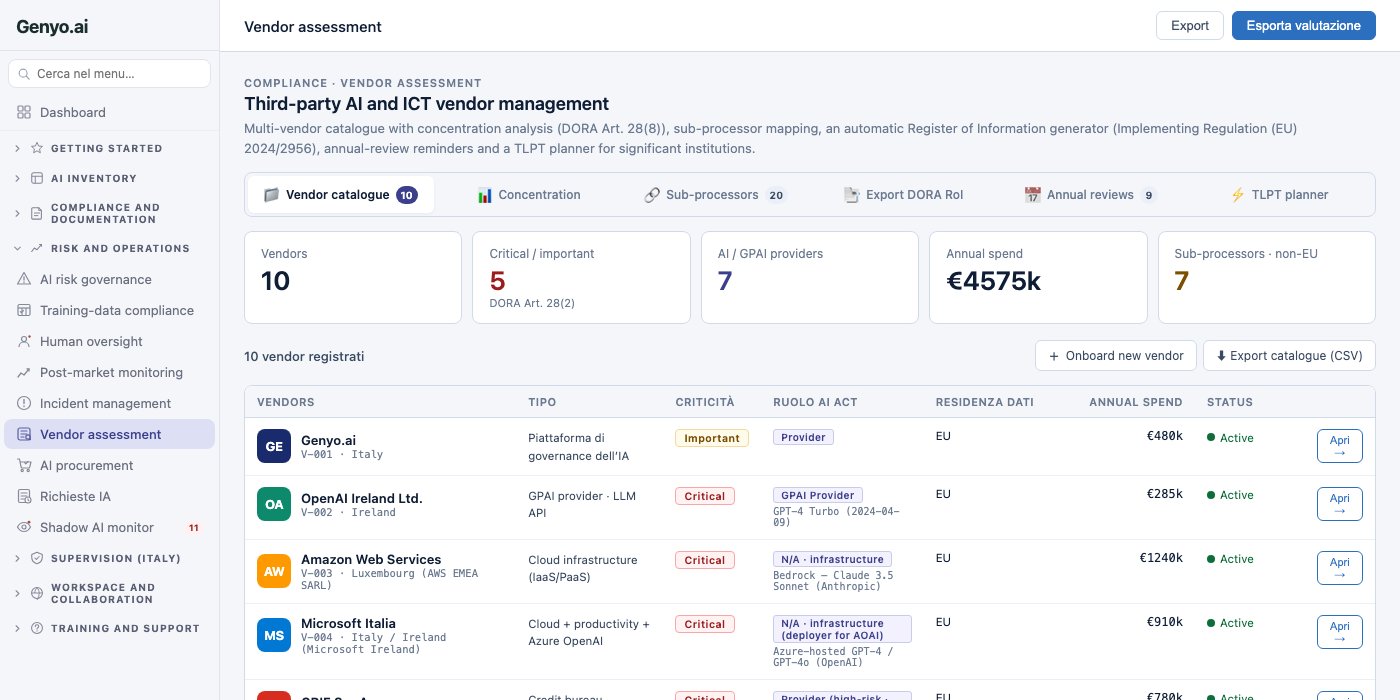
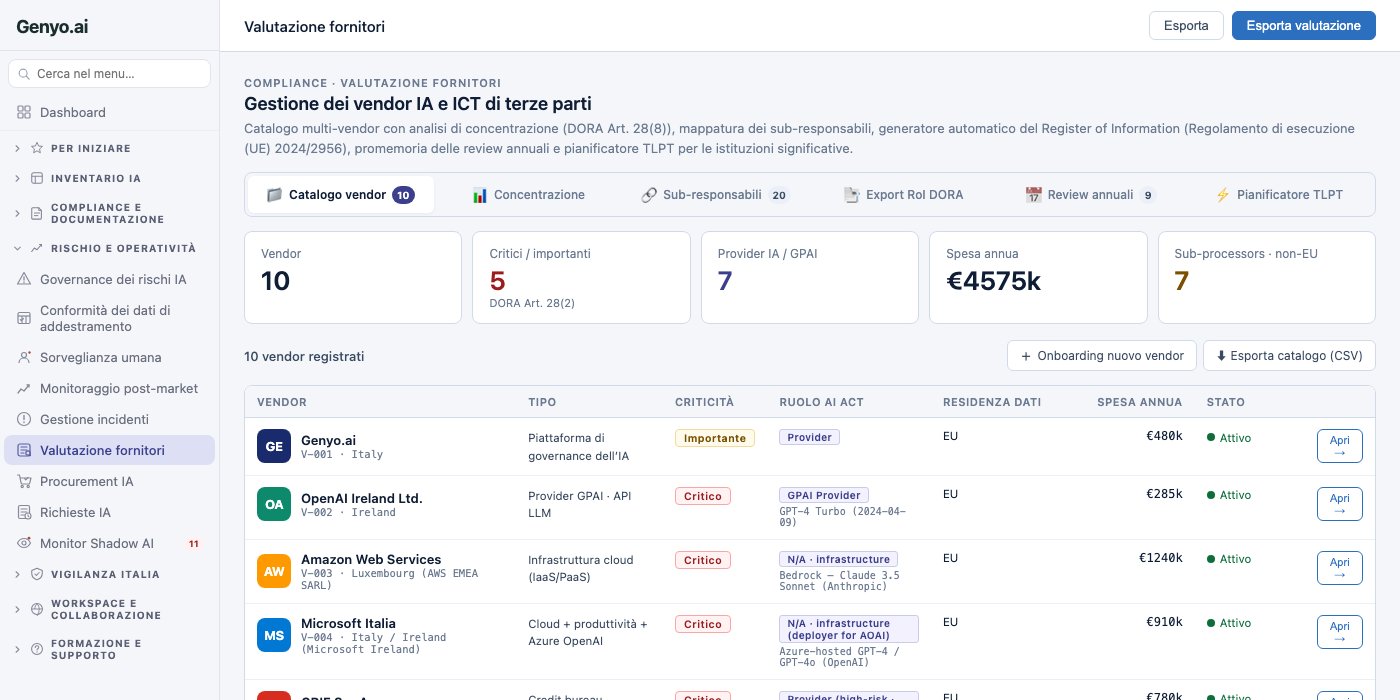
Assesses each critical ICT and AI third party against DORA Art. 28, the EBA outsourcing guidelines, AI Act Art. 11, GDPR Art. 28 and NIS2 Art. 21(2)(d): documentation, SLAs, exit strategy, concentration, replacement time and AI Act role. One green assessment per critical provider.
Products · Supervision (Italy)
Banca d'Italia template v3 · DORA
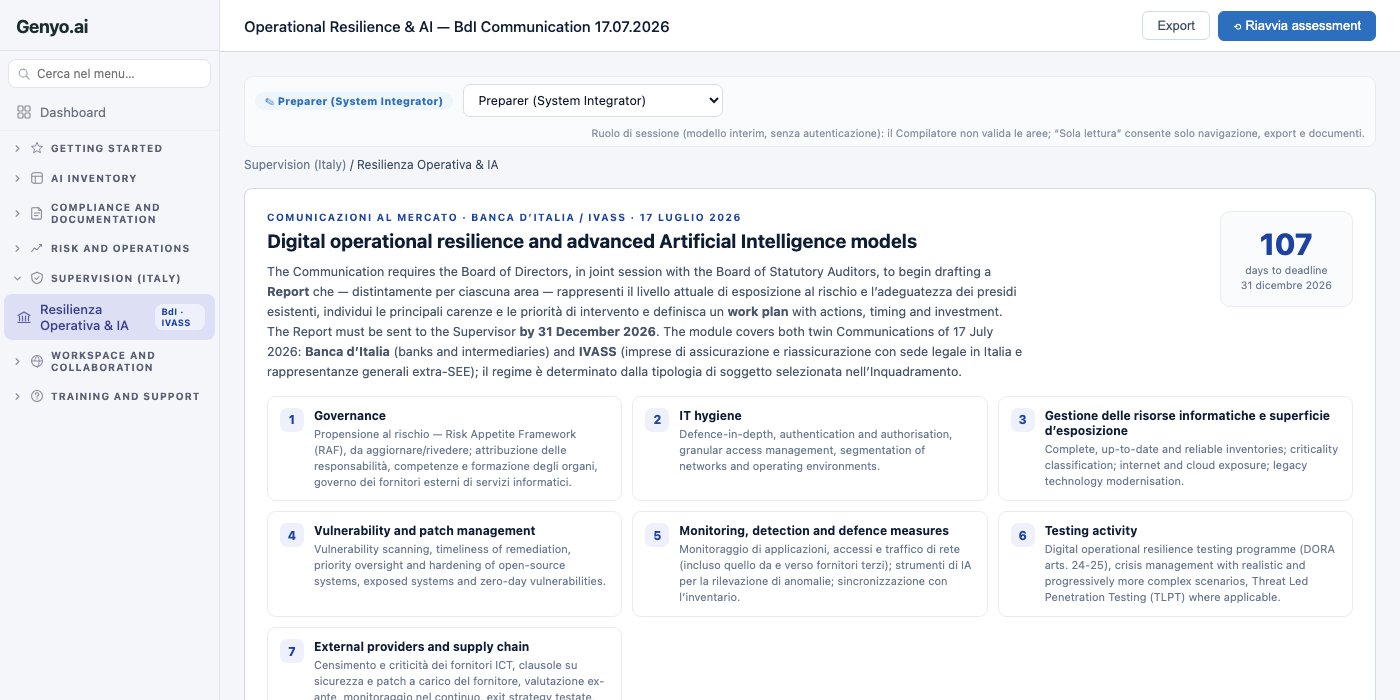
Produces the Relazione per la Vigilanza in the Banca d'Italia template (v3, September 2026 revision) from the platform's own evidence: company profile, board competencies, AI register, shadow-AI whitelist, DPIA measures, resilience testing with RTO/RPO, and the FEI register of critical ICT providers with exposure anchoring.
Build AI is Redo's pipeline for designing, developing and maintaining AI models — engineered for speed, and engineered so that every artefact the AI Act asks for is produced as the model is built. Genyo Govern AI is our proof: we built it this way.
A model that leaves Build AI arrives in Govern AI with its obligations already partly met. The Annex IV generator reads the pipeline's metadata; the training-data check is already on file; monitoring thresholds are already set.
Twenty-five modules, fourteen frameworks and eighteen connectors, designed, developed and maintained on Build AI. When we say the pipeline is fast and produces its own compliance metadata, the platform you are evaluating is the evidence.
See the modulesClassify every AI system, map it to the 135 obligations that may apply, collect evidence from the systems that produce it, and hand your supervisor a dossier that reads the way they read.
Every workflow is assigned across the three lines of defence and signed with eIDAS. The platform enforces separation of duties; the audit log proves it.
Consolidated AI risk register, 44 catalogued risks with KRI templates, sector overlays.
Obligation status by article, inspection dossier, supervisor Q&A tracker.
DPIA generated with the FRIA, Garante notifications, Art. 36 prior consultation.
Append-only ledger, evidence matrix, completeness verifier, chain integrity check.
Regulation becomes work through the obligation catalogue: 135 obligations across 14 frameworks, each tied to an article, an owner and the evidence that satisfies it. The baseline applies always; sector, NIS2 and national overlays switch on per entity.
Grouped as they appear in the product.
The Inspection dossier assembles what AgID, Banca d'Italia, CONSOB, IVASS, the Garante, ACN or the EU AI Office ask for, in the order they read it, and tracks their questions. For Italian institutions, Vigilanza Italia produces the Banca d'Italia report in the authority's own template.
General-purpose models and in-house ML need their own instruments: GPAI qualification and systemic-risk checks, training-data tests, oversight design, post-market telemetry — and a place for your evaluation and red-team results to become evidence.
Art. 51–55 qualification, 10²⁵ FLOP systemic-risk test, re-run on vendor updates.
Test a dataset against Art. 10 before training; verdict and quality band on file.
The five Art. 14(4) measures, recorded per system and auto-populated into Annex IV.
Metrics, thresholds and incident triggers under Art. 72, fed from your telemetry.
For models you train yourself, the tools follow the lifecycle the AI Act describes: data governance before training, oversight design before deployment, monitoring after.
Results from Garak, PyRIT, DeepEval and RAGAS, guardrail policies from NeMo, PII findings from Presidio — each lands against the article it supports.
Genyo Govern AI riunisce in un'unica piattaforma il controllo, la governance e la conformità di ogni sistema di IA che usi — l'AI Act, le regole del tuo settore e ogni autorità nazionale dell'Unione, con le evidenze che la vigilanza ti chiederà.
Progettato per banche, assicurazioni e gestori. Realizzato a Milano da Redo S.r.l.
Governa ciò che già usi, costruisci ciò che ti serve, controlla i modelli generali e di ML sotto a entrambi.
Inventaria, classifica e documenta ogni sistema di IA. Collegalo a ogni obbligo applicabile, raccogli le evidenze e consegna alla vigilanza un dossier.
Scopri Govern AIBuild AIProgetta, sviluppa e mantieni modelli di IA su una pipeline costruita per la velocità — con i metadati di governance generati lungo la strada, non a posteriori.
Scopri Build AIStrumentiQualifica i modelli per finalità generali, verifica i dati di addestramento, progetta la sorveglianza umana, monitora post-market — e collega il tuo stack di valutazione e red-team.
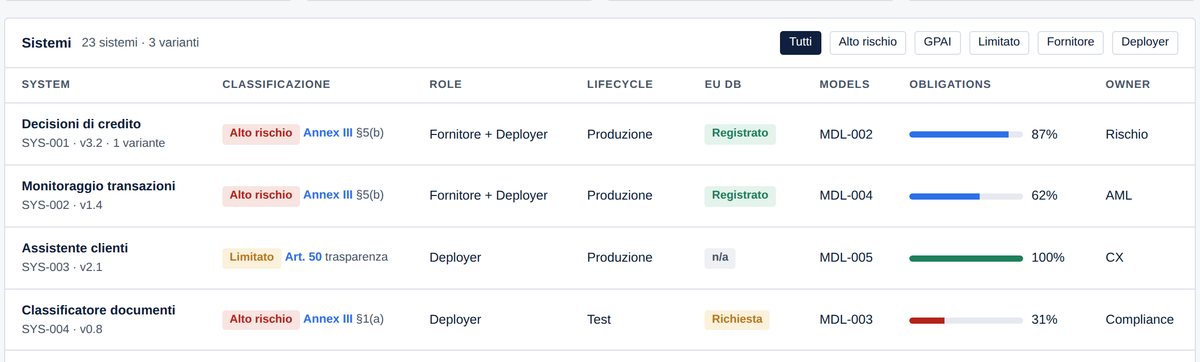
Scopri gli strumentiClasse di rischio, categoria Allegato III, ruolo di fornitore o deployer, ciclo di vita, stato nella banca dati UE, modelli in uso e rischi collegati — una riga per sistema, per entità. È il registro che la vigilanza chiederà di vedere.
Un incidente ai sensi dell'AI Act è quasi sempre anche un incidente DORA e GDPR. Genyo collega ogni modulo a ogni articolo che lo vincola: un'azione sola soddisfa ogni regime, con le scadenze di ciascuno.
 Vedi la schermata completa →
L'AI Act è europeo. La sua applicazione è nazionale — autorità di vigilanza, template di notifica, circolari di settore, diritto del lavoro. Genyo modella le autorità e la normativa nazionale di tutti i 27 Stati membri e genera gli adempimenti che ciascuna si aspetta.
Connettori in sola lettura portano registri dei modelli, metriche, metadati di deployment e segnali di sicurezza direttamente nella base delle evidenze. Nulla viene ribattuto a mano.
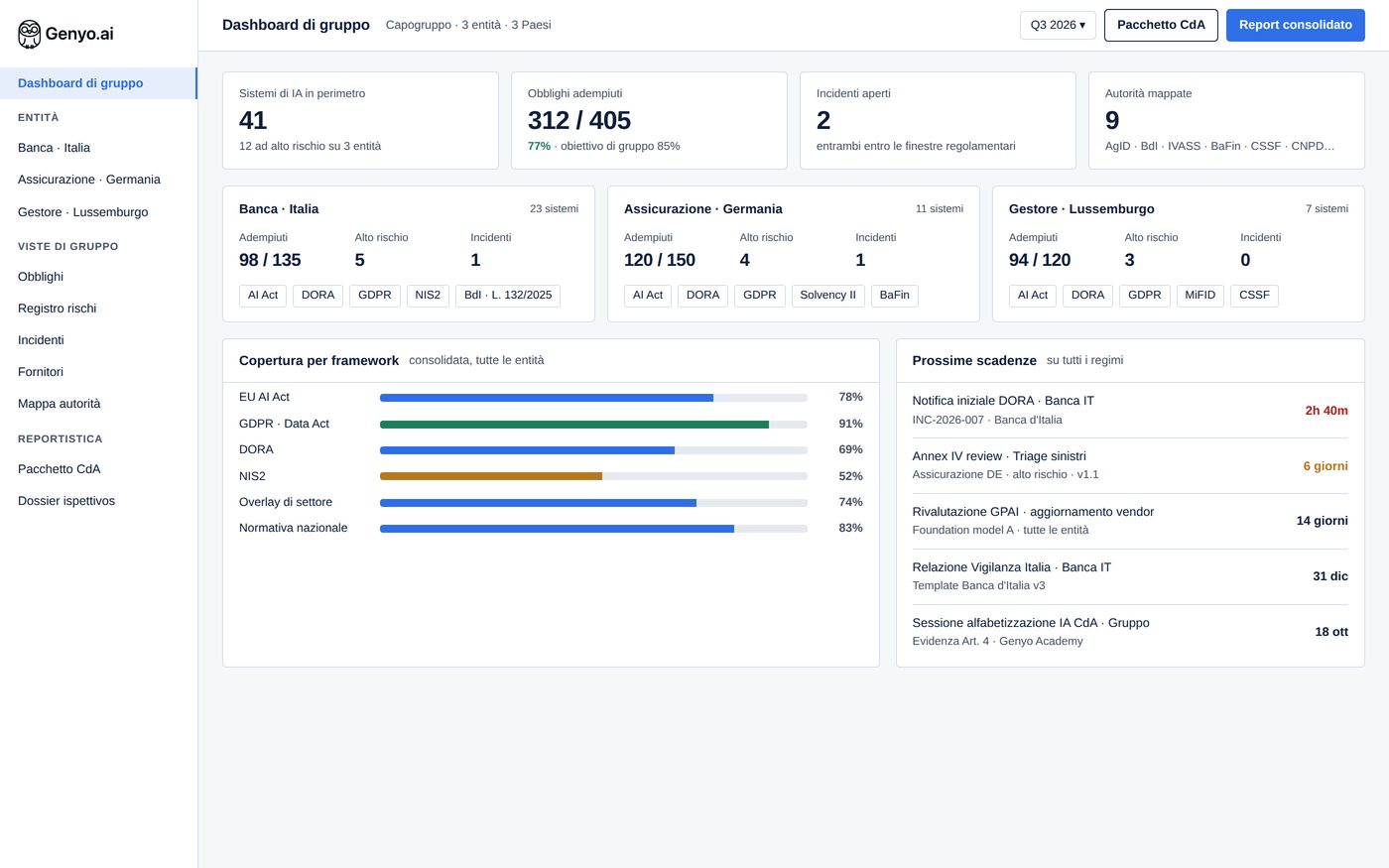
Per i gruppi la governance è un problema di consolidamento. Ogni entità giuridica mantiene registro, overlay e autorità proprie; la capogruppo vede tutto consolidato, con la separazione dei compiti garantita per entità.
 Vedi la schermata completa →
L'Art. 72 richiede un piano di monitoraggio; non dice cosa misurare. Genyo fornisce set di metriche per tipo di modello, collegati alla vostra telemetria, con soglie che aprono un incidente quando vengono superate.
 Vedi la schermata completa →
Il vostro stack di sicurezza vede già le app GenAI che i dipendenti usano. Genyo legge quell'inventario, lo correla con il catalogo dei servizi IA, ne valuta il rischio e trasforma l'uso non autorizzato in una richiesta di procurement governata — o in un blocco.
 Vedi la schermata completa →
L'Art. 14 richiede che una persona possa comprendere, mettere in discussione, annullare e fermare un sistema ad alto rischio. Genyo registra le cinque misure per sistema, chi ne è responsabile e cosa è accaduto davvero in esercizio.
 Vedi la schermata completa →
La piattaforma che stai guardando — venticinque moduli, quattordici framework, diciotto connettori — è stata progettata, sviluppata ed è mantenuta sulla pipeline Build AI. È il modo più rapido che conosciamo per portare un modello dal requisito alla produzione, e genera lungo la strada i propri metadati di conformità.
Parla con il team Build AIRedo S.r.l. è la società dietro Genyo.ai. Costruiamo software di AI governance per banche, assicurazioni e gestori, e costruiamo modelli di IA con la stessa pipeline.
L'AI Act è arrivato sopra DORA, GDPR, NIS2 e dieci anni di linee guida di settore. Alle istituzioni veniva chiesto di governare l'IA su cinque regimi con fogli di calcolo ed email.
Avevamo costruito modelli di rischio di credito sotto il controllo della vigilanza e sapevamo cosa chiede un'ispezione. Genyo è il registro che avremmo voluto avere: ogni sistema, ogni obbligo, ogni evidenza in un unico posto, nell'ordine della vigilanza.
L'abbiamo costruito sulla nostra pipeline Build AI: per questo la piattaforma produce da sé i propri metadati di conformità, e per questo offriamo la pipeline ai clienti.
Redo S.r.l. è certificata ISO/IEC 27001.
Genyo.ai opera in conformità ai requisiti DORA per i fornitori ICT terzi delle entità finanziarie.
Diteci quali entità, framework e Paesi sono in perimetro. Rispondiamo entro due giorni lavorativi con una proposta di walkthrough di 45 minuti.
Vi risponderemo il prima possibile.
Potete inviare questo modulo senza fornire nome o dati di contatto. Tutte le risposte sono trattate in modo confidenziale.
Vi risponderemo il prima possibile.
Genyo non scrive mai sulle vostre piattaforme. Ogni connettore legge registri, run, telemetria o segnali di sicurezza e li archivia come evidenze rispetto agli obblighi che soddisfano.
Diteci quale piattaforma usate e cosa dovrebbe alimentare. I connettori seguono uno schema in sola lettura, quindi la maggior parte delle richieste si risolve in settimane.
Richiedi un connettoreRedo S.r.l. (di seguito, la Società), P. IVA: 11601770966, con sede legale in Corso Garibaldi, 49, Milano, riconosce il ruolo centrale dei dati personali nell'ecosistema socio-economico in cui opera, nonché le criticità legate al loro utilizzo nella fornitura di servizi che comportano l'uso non occasionale di sistemi di intelligenza artificiale. La Società è pertanto pienamente consapevole dell'importanza di una comunicazione chiara e trasparente al fine di mitigare i rischi per i diritti e le libertà di tutte le persone fisiche i cui dati personali sono trattati. Inoltre, la normativa in materia di protezione dei dati (in particolare il Regolamento (UE) 2016/679, "Regolamento generale sulla protezione dei dati" — GDPR) ci impone di fornire le seguenti informazioni relative al trattamento dei vostri dati personali, ai sensi degli articoli 13 e 14. Per questi motivi, Redo S.r.l., Corso Garibaldi, 49 — 20121, Milano (MI), in qualità di "Titolare del trattamento", fornisce con la presente informativa le modalità di trattamento dei vostri dati personali in relazione al proprio sito web.
È importante sottolineare fin da subito che la Società, nello svolgimento delle proprie attività, opera sia come Titolare del trattamento sia come Responsabile del trattamento. Poiché, ai sensi degli articoli 13 e 14 del GDPR, l'obbligo di fornire informazioni sul trattamento spetta esclusivamente ai Titolari del trattamento, il presente documento riguarda esclusivamente le attività di trattamento per le quali la Società agisce in qualità di Titolare. Tra queste rientrano le attività legate alla registrazione al servizio e al funzionamento del sito web, relative ai dati personali delle persone fisiche che vi accedono sia come visitatori sia come operatori muniti di credenziali di accesso, ai fini della fruizione dei servizi offerti. Tuttavia, nell'interesse della trasparenza e nello spirito di leale collaborazione con i Titolari del trattamento, la Società ritiene utile fornire ai propri clienti informazioni relative alle attività di trattamento svolte in qualità di Responsabile del trattamento. Tra queste rientrano le attività derivanti dalla fornitura dei propri servizi tipici (controlli di qualità, arricchimento e ampliamento dei dati di addestramento, addestramento iniziale o ri-addestramento dei modelli, elaborazione e restituzione delle inferenze per le finalità scelte dai clienti tra quelle disponibili, e conservazione dei file originali del database per l'addestramento). A tal fine, su richiesta dei clienti-Titolari, è disponibile la Valutazione d'Impatto sulla Protezione dei Dati (DPIA) predisposta a seguito della valutazione d'impatto ai sensi dell'articolo 35 del GDPR. Estratti del documento possono inoltre essere messi a disposizione di terzi, su richiesta, nell'interesse della massima trasparenza. Va tuttavia precisato che, per quanto riguarda i trattamenti svolti in qualità di Responsabile del trattamento, la Società non determina le specifiche finalità e categorie di dati personali utilizzati di volta in volta (che dipendono in parte dalle scelte discrezionali dei clienti), i termini finali di conservazione dei dati, i soggetti a cui i Titolari scelgono di comunicarli, né numerosi altri aspetti rilevanti del trattamento, ad eccezione di quelli specificamente legati alle caratteristiche tecniche dei servizi forniti. Inoltre, la Società non è in grado di rispondere direttamente e autonomamente alle richieste degli interessati, non conoscendo l'identità delle persone coinvolte, operando esclusivamente su informazioni non riconducibili a specifiche persone fisiche (dati pseudonimizzati all'origine e pertanto anonimi dal punto di vista della Società, che non possiede, né può possedere, mezzi legali o tecnici per re-identificare gli interessati). Ciò nonostante, la DPIA sopra citata contiene informazioni relative alle misure tecniche "by design" adottate per agevolare l'esercizio dei diritti degli interessati da parte dei clienti-Titolari, in particolare con riferimento alla spiegabilità delle inferenze dei modelli di IA e alla supervisione umana dei processi (supervisione "human-in-the-loop"), in conformità all'articolo 22 del GDPR nonché alla normativa correlata in materia di Intelligenza Artificiale (Reg. (UE) 2025/1689 e normative settoriali, ad es. EBA). Infine, si precisa che le operazioni svolte dalla Società ai fini dello sviluppo di ulteriori modelli di IA per proprio interesse sono normalmente effettuate utilizzando dati sintetici o dati sottoposti a processi (embedding) che li rendono completamente anonimi e non riconducibili a persone fisiche identificate o identificabili, e che pertanto non costituiscono trattamento di dati personali ai sensi dell'articolo 4, paragrafo 2, del GDPR. Qualora in futuro venissero utilizzati dati personali per le finalità descritte nel presente paragrafo, sarà responsabilità del Titolare del trattamento (che sia la Società, il cliente o, in caso di contitolarità, il soggetto designato secondo gli accordi ad assumere tale obbligo) informare gli interessati e garantire l'esistenza delle basi giuridiche necessarie.
Ogni modulo porta con sé l'articolo che lo vincola. Insieme coprono AI Act, GDPR, DORA, NIS2 e gli overlay di settore e nazionali — dalla prima classificazione al dossier per la vigilanza.
Prodotti · Per iniziare
EU AI Act · L. 132/2025
Un questionario guidato che posiziona l'organizzazione rispetto all'AI Act, alla L. 132/2025 e agli overlay di settore applicabili. Il risultato è una lista di gap con responsabili, usata per pianificare i primi novanta giorni sulla piattaforma.
Prodotti · Inventario IA
EU AI Act Art. 11 · Annex IV §2 · Art. 51–55
La scheda tecnica di ogni modello dietro un sistema: architettura, finalità di addestramento, parametri, compute, capacità e lineage — sincronizzati dalle piattaforme ML invece che inseriti a mano. Alimenta l'Allegato IV §2 e la qualificazione GPAI.
Prodotti · Rischio e operatività
EU AI Act Art. 26 · Art. 4
Un canale governato per la nuova domanda di IA: intake, verifica delle funzioni, valutazione di procurement, decisione, poi classificazione nel registro. È la mitigazione strutturale dello shadow AI: sposta la domanda dal canale ombra a uno governato con audit trail hash-chained.
Prodotti · Vigilanza Italia
EU AI Act + L. 132/2025 + DORA · NIS2 · MiFID · Solvency II
Un'unica valutazione regolamentare che legge l'AI Act insieme alla L. 132/2025 e alla normativa di settore applicabile all'entità — DORA, NIS2, MiFID, Solvency II — e produce l'insieme degli obblighi applicabili per il catalogo.
Prodotti · Rischio e operatività
All 14 frameworks
Il registro dei rischi IA: 44 rischi a catalogo con template KRI, overlay settoriali, responsabili e piani di trattamento, organizzati secondo le comunicazioni di Banca d'Italia e IVASS sulla gestione dei rischi. Ogni rischio è collegato agli obblighi che minaccia e ai controlli che lo mitigano.
Prodotti · Inventario IA
EU AI Act Art. 6 + Annex III
Una classificazione in tre passi che assegna la classe di rischio di ogni sistema ai sensi dell'Art. 6 e dell'Allegato III, registra la motivazione e segnala la componente IA NIS2 dove l'entità rientra nel D.Lgs. 138/2024. La classificazione determina quali obblighi si applicano a valle.
Prodotti · Inventario IA
EU AI Act Art. 49 · Fw 132/2025 §5.1
Il registro unico di ogni sistema di IA fornito o utilizzato: responsabile, finalità, stato, entità, classificazione ed eventi del ciclo di vita. È la fonte da cui leggono tutti gli altri moduli e il record che va nella banca dati UE ai sensi dell'Art. 49.
Prodotti · Compliance e documentazione
EU AI Act Art. 11 · Annex IV
Genera il dossier di documentazione tecnica dell'Allegato IV richiesto dall'Art. 11 per i sistemi ad alto rischio. Nove sezioni precompilate dai metadati di sistema e, per i modelli costruiti con Build AI, direttamente dalla pipeline di addestramento. Controllo di versione e flusso di revisione rendono ogni dossier difendibile.
Prodotti · Compliance e documentazione
EU AI Act Ch. I–XII
Le autorità ragionano per articolo. Il cockpit mostra l'intera struttura dell'AI Act, Capi I–XII, con stato, maturità ed evidenze per ogni articolo su tutti i sistemi: la vista incrociata che serve prima di un'ispezione.
Prodotti · Per iniziare
EU AI Act Art. 4 · Fw 132/2025
L'anagrafica di ogni entità giuridica: settore, posizione nel gruppo, overlay applicabili, soglie di escalation, competenze del Consiglio e formazione svolta o pianificata. Ogni valutazione e ogni relazione di vigilanza legge da qui: si compila una volta sola.
Prodotti · Compliance e documentazione
AI Act · GDPR · Data Act · DORA · NIS2
Una checklist operativa derivata dal catalogo: la baseline sempre applicabile, la lente NIS2 componente IA per le entità in perimetro e l'overlay di settore — DORA e linee guida EBA per i servizi finanziari. Ogni voce ha stato, maturità ed evidenze.
Prodotti · Compliance e documentazione
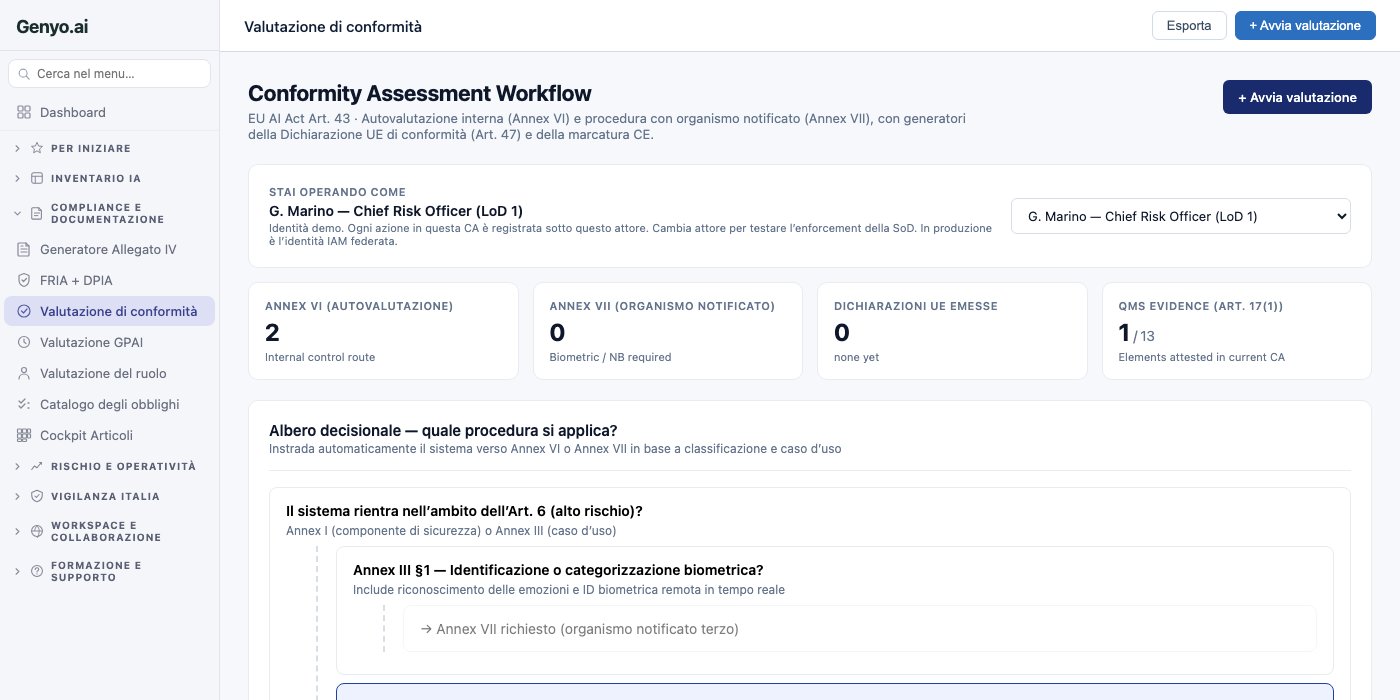
EU AI Act Art. 43 + Art. 47
Instrada ogni sistema ad alto rischio verso la procedura corretta — controllo interno Annex VI per la maggior parte dei casi d'uso finanziari, organismo notificato Annex VII per i sistemi biometrici — e la esegue: prontezza QMS, matrice delle evidenze, verifica di completezza, poi Dichiarazione UE di conformità e marcatura CE. Nove ruoli sulle tre linee di difesa firmano con eIDAS.
Prodotti · Workspace, formazione e supporto
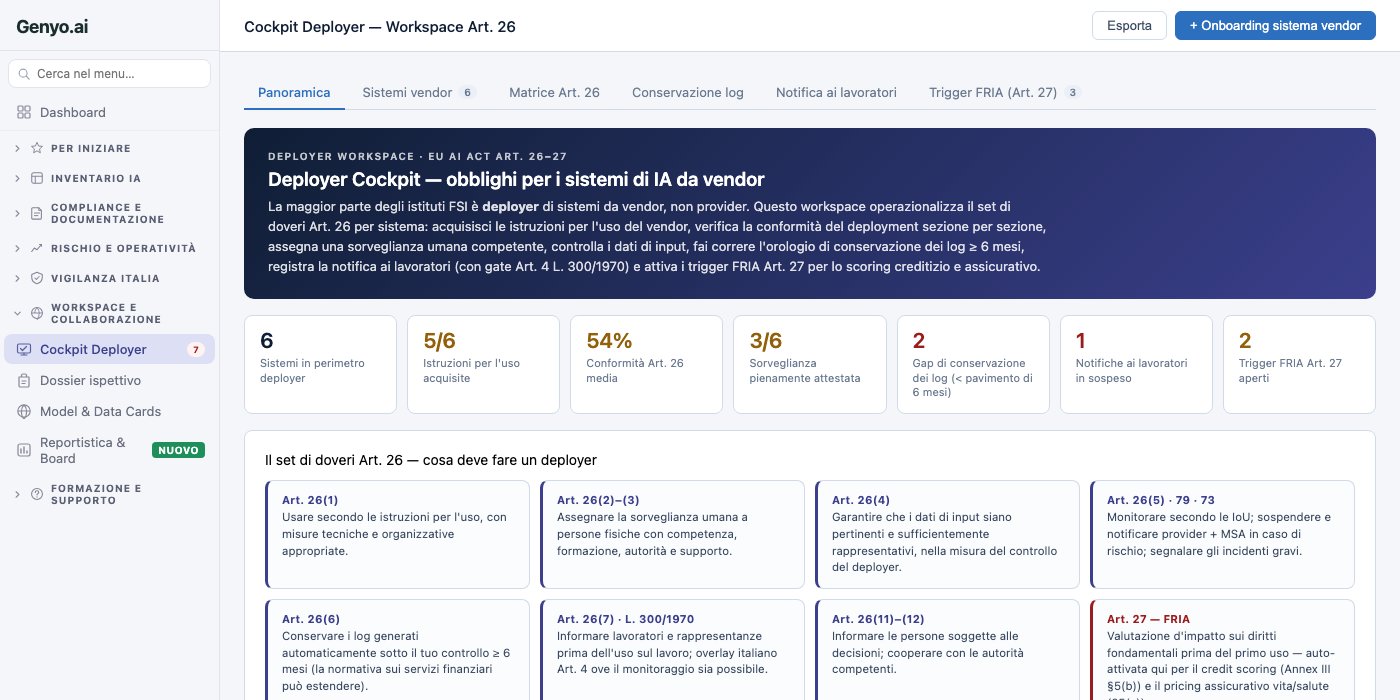
EU AI Act Art. 26
Tutto ciò che un deployer deve ai sensi dell'Art. 26 in un unico workspace: uso secondo le istruzioni, assegnazione di sorveglianza umana competente, pertinenza dei dati di input, monitoraggio del funzionamento, conservazione dei log, informazione delle persone interessate, cooperazione con le autorità e FRIA.
Prodotti · Compliance e documentazione
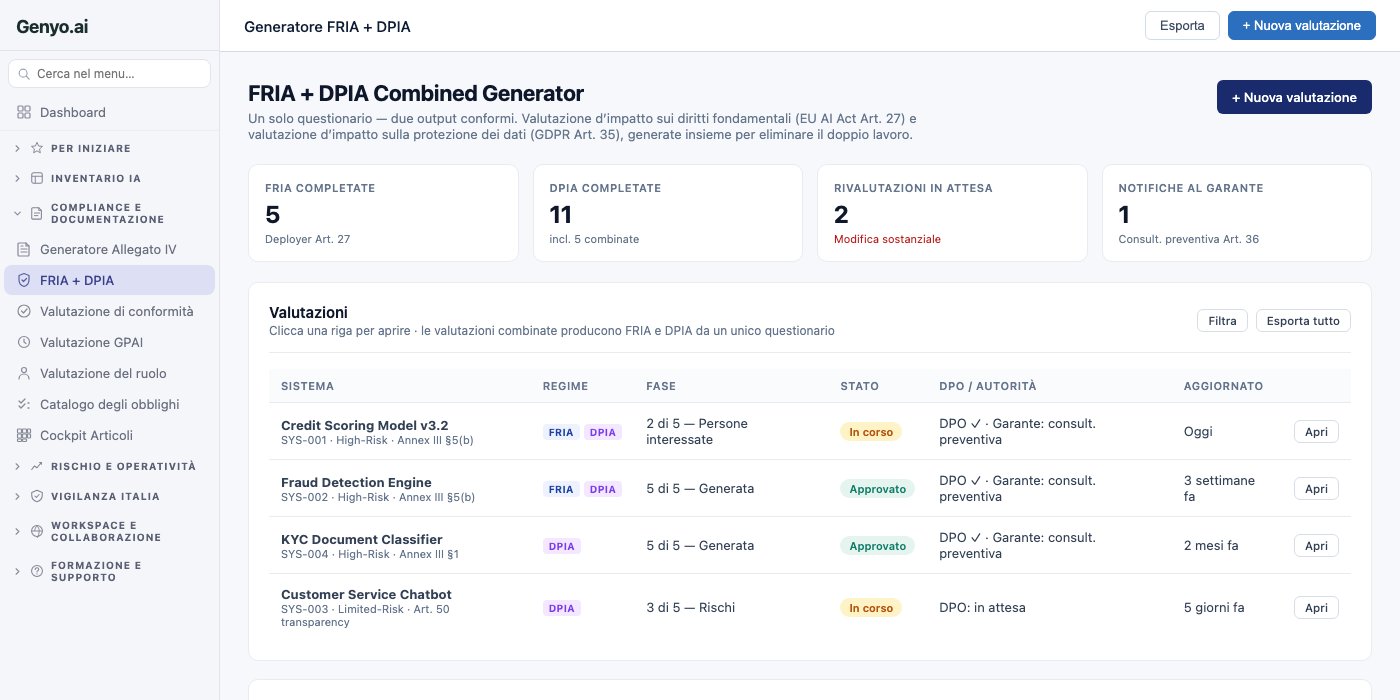
EU AI Act Art. 27 + GDPR Art. 35
La valutazione d'impatto sui diritti fondamentali (AI Act Art. 27) e quella sulla protezione dei dati (GDPR Art. 35) condividono gran parte delle domande. Genyo le pone una volta sola, instrada il caso verso solo FRIA, solo DPIA o combinata, e genera entrambi i documenti in tempo reale.
Prodotti · Workspace, formazione e supporto
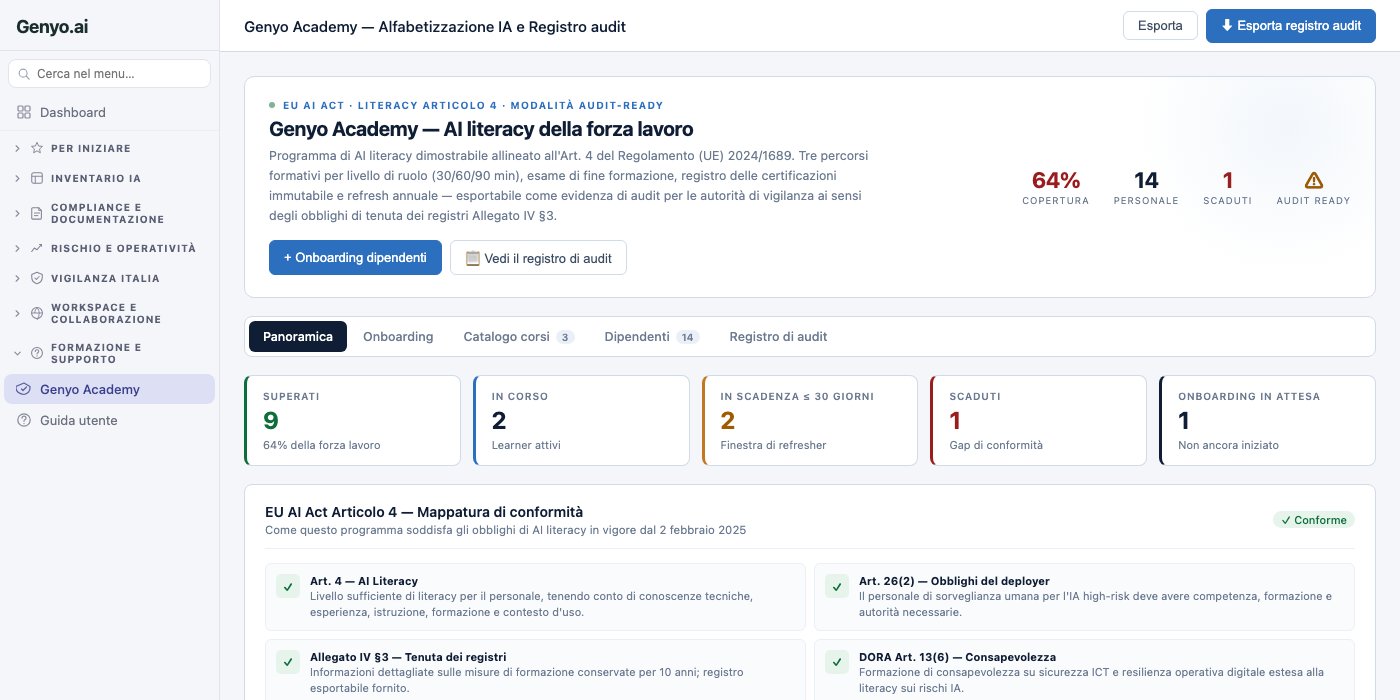
EU AI Act Art. 4 · Fw 132/2025 §9.1
Il percorso di alfabetizzazione IA richiesto dall'Art. 4, organizzato per ruolo e livello — dai consiglieri di amministrazione ai revisori dei modelli. Ogni completamento è scritto nel registro di audit come evidenza e lo stato Academy compare nella Relazione per la Vigilanza.
Prodotti · Compliance e documentazione
EU AI Act Art. 51–55
Stabilisce se un modello è un modello di IA per finalità generali, se comporta rischio sistemico rispetto alla soglia di 10²⁵ FLOP e quali obblighi degli Artt. 53–55 ne derivano per fornitore e deployer. Si riesegue automaticamente quando il vendor pubblica una nuova versione.
Prodotti · Rischio e operatività
EU AI Act Art. 14 · Art. 26(2)
Progetta e registra le misure di sorveglianza umana richieste dall'Art. 14(4)(a–e) per ogni sistema ad alto rischio, e l'assegnazione di sorveglianza competente da parte del deployer ai sensi dell'Art. 26(2). Il design popola automaticamente l'Allegato IV §2(e).
Prodotti · Rischio e operatività
EU AI Act Art. 73 + DORA Art. 19 + GDPR Art. 33 + NIS2 Art. 23
Segnala un incidente grave una volta sola. Genyo ne classifica la gravità, individua gli altri regimi che attiva, avvia ogni scadenza e precompila la notifica di ciascuna autorità dallo stesso record: AgID per l'AI Act, Banca d'Italia per DORA, il Garante per il GDPR, ACN per NIS2.
Prodotti · Workspace, formazione e supporto
All supervisors
Assembla il pacchetto che l'autorità richiede — registri, classificazioni, valutazioni, evidenze, registro di audit — nell'ordine in cui lo legge, e traccia domande e risposte durante l'ispezione. Copre le autorità dei servizi finanziari, i regolatori delle utilities e le autorità NIS2.
Prodotti · Per iniziare
Product configuration
Una procedura guidata per ogni connettore: cosa alimenta, quali credenziali servono (sempre in sola lettura) e cosa succede alla prima sincronizzazione. Registri dei modelli, metriche, metadati di deployment e segnali di sicurezza arrivano nella base delle evidenze senza ribattitura.
Prodotti · Workspace, formazione e supporto
Annex IV §2 · GDPR Art. 30 · Fw 132/2025 §6.1
Una scheda di trasparenza per modello leggibile da revisori, auditor e — dove richiesto — persone interessate: finalità, architettura, dati, limiti, sorveglianza e registro dei trattamenti GDPR Art. 30. I revisori vedono la scheda prima della decisione.
Prodotti · Compliance e documentazione
14 frameworks
Dove la regolamentazione diventa lavoro. 135 obblighi su 14 framework, ciascuno con responsabile, stato, livello di maturità e collegamenti alle evidenze che lo soddisfano. La baseline trasversale (AI Act, GDPR, Data Act) si applica sempre; gli overlay di settore e NIS2 si attivano per entità.
Prodotti · Rischio e operatività
EU AI Act Art. 72
Costruisce il piano di monitoraggio post-market richiesto dall'Art. 72: metriche rilevate dalle piattaforme collegate, soglie, cadenza di reporting e trigger che aprono un incidente. Un drift oltre la tolleranza diventa automaticamente un record di incidente.
Prodotti · Compliance e documentazione
EU AI Act Art. 25–27
Ai sensi degli Artt. 3 e 25, il ruolo ricoperto per ciascun modello determina gli obblighi. Il wizard stabilisce fornitore o deployer per modello e per servizio, elenca gli obblighi Artt. 9–17 che ne conseguono e produce le clausole contrattuali e la registrazione Allegato IV o VIII applicabili.
Prodotti · Rischio e operatività
EU AI Act Art. 4 · Art. 26 · L. 300/1970 Art. 4
Legge l'inventario delle applicazioni GenAI scoperte dallo stack di sicurezza — Purview, Netskope, Zscaler, Harmonic Security, Reco — con scoring di rischio, grant OAuth ed eventi di esposizione di dati sensibili, e li correla con il catalogo dei servizi IA. Gli strumenti rilevanti sono promossi nel registro; gli eventi DLP possono aprire incidenti.
Prodotti · Rischio e operatività
EU AI Act Art. 10
Verifica se un dataset soddisfa i requisiti dell'Art. 10 su governo dei dati, pertinenza, rappresentatività ed esame dei bias prima che l'addestramento inizi. Verdetto e fascia di qualità sono conservati con il modello e riutilizzati nell'Allegato IV.
Prodotti · Rischio e operatività
DORA Art. 28 · EBA GL/2022/05 · AI Act Art. 11 · GDPR Art. 28
Valuta ogni terza parte ICT e IA critica rispetto a DORA Art. 28, linee guida EBA sull'outsourcing, AI Act Art. 11, GDPR Art. 28 e NIS2 Art. 21(2)(d): documentazione, SLA, exit strategy, concentrazione, tempo di sostituzione e ruolo AI Act. Una valutazione verde per ogni fornitore critico.
Prodotti · Vigilanza Italia
Banca d'Italia template v3 · DORA
Produce la Relazione per la Vigilanza nel template di Banca d'Italia (v3, revisione settembre 2026) dalle evidenze della piattaforma: dati aziendali, competenze dell'organo, registro IA, whitelist shadow AI, misure DPIA, test di resilienza con RTO/RPO e registro FEI dei fornitori ICT critici con ancoraggio delle esposizioni.
Build AI è la pipeline di Redo per progettare, sviluppare e mantenere modelli di IA — costruita per la velocità, e costruita perché ogni artefatto richiesto dall'AI Act venga prodotto mentre il modello nasce. Genyo Govern AI è la nostra prova: l'abbiamo costruito così.
Un modello che esce da Build AI arriva in Govern AI con gli obblighi già in parte adempiuti. Il Generatore Allegato IV legge i metadati della pipeline; la verifica dei dati è già agli atti; le soglie di monitoraggio sono già impostate.
Venticinque moduli, quattordici framework e diciotto connettori, progettati, sviluppati e mantenuti su Build AI. Quando diciamo che la pipeline è veloce e produce da sé i metadati di conformità, la piattaforma che state valutando è l'evidenza.
Scopri i moduliClassifica ogni sistema di IA, collegalo ai 135 obblighi potenzialmente applicabili, raccogli le evidenze dai sistemi che le producono e consegna alla vigilanza un dossier scritto come lo legge.
Ogni flusso è assegnato sulle tre linee di difesa e firmato con eIDAS. La piattaforma applica la separazione dei compiti; il registro di audit lo dimostra.
Registro dei rischi IA consolidato, 44 rischi a catalogo con template KRI, overlay di settore.
Stato degli obblighi per articolo, dossier ispettivo, tracker delle richieste della vigilanza.
DPIA generata con la FRIA, notifiche al Garante, consultazione preventiva Art. 36.
Registro append-only, matrice delle evidenze, verificatore di completezza, controllo di integrità della catena.
La regolamentazione diventa lavoro attraverso il catalogo degli obblighi: 135 obblighi su 14 framework, ciascuno legato a un articolo, a un responsabile e alle evidenze che lo soddisfano. La baseline si applica sempre; overlay di settore, NIS2 e nazionali si attivano per entità.
Raggruppati come compaiono nel prodotto.
Il Dossier ispettivo assembla ciò che AgID, Banca d'Italia, CONSOB, IVASS, Garante, ACN o l'AI Office UE richiedono, nell'ordine in cui lo leggono, e traccia le loro domande. Per le istituzioni italiane, Vigilanza Italia produce la Relazione per Banca d'Italia nel template dell'autorità.
I modelli per finalità generali e il ML interno hanno bisogno di strumenti propri: qualificazione GPAI e verifiche di rischio sistemico, test sui dati di addestramento, progettazione della sorveglianza, telemetria post-market — e un posto dove i risultati di valutazione e red-team diventano evidenze.
Qualificazione Artt. 51–55, verifica di rischio sistemico 10²⁵ FLOP, riesecuzione agli aggiornamenti del vendor.
Verifica un dataset rispetto all'Art. 10 prima dell'addestramento; verdetto e fascia di qualità agli atti.
Le cinque misure Art. 14(4), registrate per sistema e riportate automaticamente nell'Allegato IV.
Metriche, soglie e trigger degli incidenti ai sensi dell'Art. 72, alimentati dalla tua telemetria.
Per i modelli che addestrate voi, gli strumenti seguono il ciclo di vita descritto dall'AI Act: governo dei dati prima dell'addestramento, sorveglianza prima del deployment, monitoraggio dopo.
Risultati di Garak, PyRIT, DeepEval e RAGAS, policy dei guardrail NeMo, rilevazioni PII di Presidio — ciascuno si aggancia all'articolo che supporta.
A 45-minute walkthrough with the Redo team, on your AI systems, your frameworks and your countries.
Quarantacinque minuti con il team Redo, sui tuoi sistemi di IA, i tuoi framework e i tuoi Paesi.